


Growth Marketing
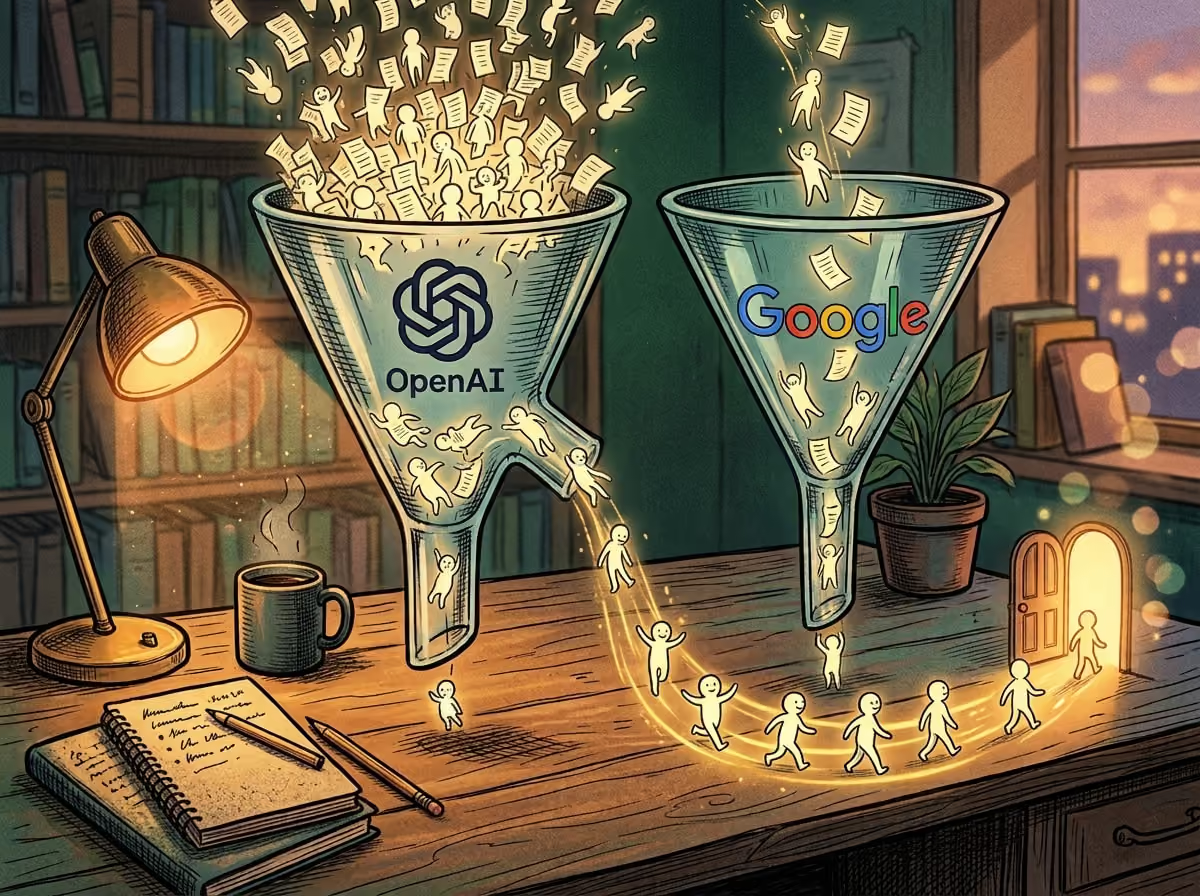
The question I keep getting from founders and marketing leads right now is some version of this: should we pull part of our Google Search budget and put it into ChatGPT Ads?
It's a fair question. ChatGPT Ads launched in February, and by the end of August OpenAI said the ads business had already hit a $1 billion annualized run rate. This month the platform added cost-target bidding, which makes it feel a lot more like a grown-up ad channel. When something grows that fast, nobody wants to be the last one in.
But I've spent the past couple of weeks going through the first real performance data on this channel, and my honest read is that most of the numbers flying around LinkedIn are being used to answer a question they can't answer. Some of the data is genuinely useful. Some of it is math stacked on top of assumptions. And almost none of it tells you what will happen in your own account.
So here's what the early evidence actually shows, where it gets shaky, and how I'd run a test if you're going to spend money on this anyway.
$1B+
Annualized ChatGPT Ads run rate, with over 100,000 advertisers since launch, per OpenAI's engineering team
$0.89 vs $2.45
Revenue per U.S. session from ChatGPT ads vs. paid search, in a working paper on 102 tracked sites
84 of 87
Advertisers running both channels who earned less revenue per visit from ChatGPT ads
Is Money Actually Leaving Google Yet?
Let's start with the budget question, because that's what everyone wants to know. Is ChatGPT pulling dollars away from Google Search?
The honest answer is that nobody can show it yet. OpenAI's own numbers tell you the ads business is growing fast. Alphabet's numbers tell you search is still growing too. Alphabet reported $63.35 billion in Search & other revenue for the third quarter, up 12% year over year. On the earnings call, Google's leadership pointed to lower monetization in AI Mode as one reason search growth slowed, but didn't attach a number or a baseline to it.
Then there's the survey data. A Bank of America survey of 117 advertisers and agencies found Google Search was the most-mentioned place future ChatGPT ad dollars would come from, as TheStreet reported in October. That's interesting, but it measures plans, not money that has actually moved.
📌 Did You Know
Both things can be true at once. Google can keep growing search revenue while individual advertisers quietly shift a slice of their budgets elsewhere. Neither company's revenue report isolates spend that moved from one platform to the other, so any claim that "budgets are flooding out of Google" is a guess dressed up as a trend.
Here's why that matters for you. If your board or your CEO is pushing you to move money because "everyone else is," the data doesn't back up that premise. What you actually need is evidence about performance, and that's where things get more interesting.
What the Per-Visit Numbers Really Say
The most useful piece of research so far is a working paper from two e-commerce researchers who looked at first-party data from sites tracking both transactions and revenue. In U.S. traffic, a visit from a paid search ad generated $2.45 in revenue per session. A visit from a ChatGPT ad generated $0.89. Conversion rates were 1.17% for paid search and 0.37% for ChatGPT ads.
So a ChatGPT ad visit was worth roughly a third of a search ad visit. That's a big gap, and it held up in a few ways that make me take it seriously:
- It controlled for the obvious stuff. The authors built a model that accounted for website, device type, and week, and ChatGPT ad sessions still converted less and earned less per session.
- It wasn't driven by one outlier. The result held when individual advertisers were removed from the analysis.
- It showed up almost everywhere. Of the 87 advertisers who ran both channels in U.S. traffic, 84 earned less revenue per session from ChatGPT ads.
Now for the caveats, because there are several and they're important.
The data covers 60 weeks ending August 22, but there were only up to 28 weeks of ChatGPT ad traffic to study in the U.S. That's early days for a platform that's been shipping new features almost monthly. Purchases were also heavily concentrated: according to coverage of the paper's findings, a single advertiser accounted for about two-thirds of all purchases from paid ChatGPT traffic across the sample, and only 18 of the 102 sites recorded any transactions from ChatGPT ads at all.
About 20% of the sites were services, software, education, or finance businesses, where a "conversion" is a booking, a lead, a license, or a sign-up. The paper's appendix defines a transaction as a completed order, and it doesn't explain how those two kinds of outcomes were reconciled. If you sell software, that's a meaningful gap.
The authors are also careful to call their work descriptive, not causal. Advertisers chose to buy ChatGPT ads, so the paper records what those sites got from each channel. It doesn't prove ChatGPT ads are worse for any specific advertiser, and it doesn't tell you what would happen if you moved budget under matched conditions.
✅
Disclosure worth knowing: The data was donated by a commerce analytics company where one of the authors is a scientific advisor and a former employee. The authors state the company played no role in the research. OpenAI, for its part, told reporters the study reflects an earlier period of the product and extrapolates from a small sample, and noted that Target CPA and Target CPC have launched since.

The "$0.52 vs. $3.40" Headline Is Math, Not Measurement
If you've seen a headline saying ChatGPT Ads return $0.52 for every dollar while Google returns $3.40, this is where I'd slow down. Those numbers came from a university press release tied to the paper, which framed Google as delivering about 6.6 times better value for money.
Only the revenue-per-visit figures were actually measured. The per-dollar figures were built by dividing those measured numbers by a click price. Here's how:
| Input | ChatGPT Ads | Google Search | Where it came from |
|---|---|---|---|
| Revenue per session | $0.89 | $2.45 | Measured across tracked sites |
| Cost per click used | $1.72 | $0.72 | One agency's published account vs. a median from 16 accounts |
| Revenue per ad dollar | ~$0.52 | ~$3.40 | Calculated, not measured |
Look at where those click prices come from. The $0.72 search figure is a median from 16 mostly U.S. accounts with linked Google Ads cost data, and it wasn't matched to the revenue each site generated. The $1.72 ChatGPT figure comes from a single account an agency published in June: about $60,000 in spend over 15 days, on campaigns the agency had already scaled because they looked promising. The agency itself said those numbers weren't an average of every test it ran, and it reported a 1.49x ROAS on that account.
Only one website in the paper's sample matched that agency account on both conversion rate and implied revenue per visit, and it had just nine ChatGPT ad sessions. So you've got a best-case price from one account sitting next to a median price from a different group of accounts, and the result gets presented as one clean ratio.
The per-dollar figure moves with whatever you pay per click. Change the click price and the headline changes with it.
To be fair to the authors, they argue $1.72 is conservative. It sits toward the low end of what practitioners report, and it's below the $3 to $5 OpenAI suggests as a starting maximum bid. Keep in mind a max bid is a ceiling you set, not what every click actually costs.
The more useful number in the paper is what they call the parity price: the cost per click at which ChatGPT ads would match search on revenue per dollar. Holding the search price steady and resampling advertisers, they landed at about $0.26 per click, with a range of roughly $0.05 to $0.57.
💡
Run the parity math on your own account: divide ChatGPT ad revenue per visit by search ad revenue per visit, then multiply by what you actually pay per click on search. If you pay $3.50 per search click and the paper's ratio held for you (about 0.36), your break-even ChatGPT click would be around $1.27. Your own numbers will differ, and that's the point. Use your data, not someone else's.
What the Early Agency Case Studies Show
Beyond the paper, a handful of agencies have published results from their own ChatGPT Ads tests. Each covers one advertiser, and each was built differently, so I'd read them as signals rather than benchmarks. I've left out the agency names because what matters here is the pattern, not the pitch.
| Test | ChatGPT Ads | Google Search | The catch |
|---|---|---|---|
| B2B compliance company, 30 days | $0.76 CPC, $92.21 per lead, 0.8% conversion rate | $10.46 CPC, $157.57 per lead, 6.64% conversion rate | Google leads appear to be turning into customers at a higher rate, and the sales cycle is too long to know final cost per customer |
| B2B agency testing with its own budget, $2,319 spend | $3.14 CPC, 1.1% CTR, zero qualified leads | $6.76 CPC, 5.2% CTR, two qualified leads | The agency itself called it not a direct comparison and didn't share Google spend or dates |
| Single click campaign, one ad, June to late August | $1,524 spend, 263 clicks, one form submission | Outside benchmarks only | No same-period Google campaign to compare against |
| Form-building software company (OpenAI customer story) | Cost per sign-up about 30% lower than paid search | Internal comparison | No costs disclosed, no detail on attribution, and sign-ups aren't sales |
The first test is the one I find most instructive. On the surface, ChatGPT looks like a steal: clicks at a fraction of the price and leads about 40% cheaper. But the agency running it said the Google leads seem to be closing into customers at a better rate so far. Cheaper leads that don't close aren't cheaper. They're just earlier in the funnel.
The paid media lead behind the third test summed it up in a way that stuck with me: the clicks are priced like search, but the traffic seems to behave more like paid social. I think that framing is worth holding onto. Someone in the middle of a ChatGPT conversation is often still exploring. Someone typing a query into Google with a product name in it is often closer to buying.
Notice what all of these have in common. Every one of them gets fuzzy at the same point: what happened after the click. That's the stage with the least data, and it's the only stage that pays your bills.
How I'd Actually Test ChatGPT Ads
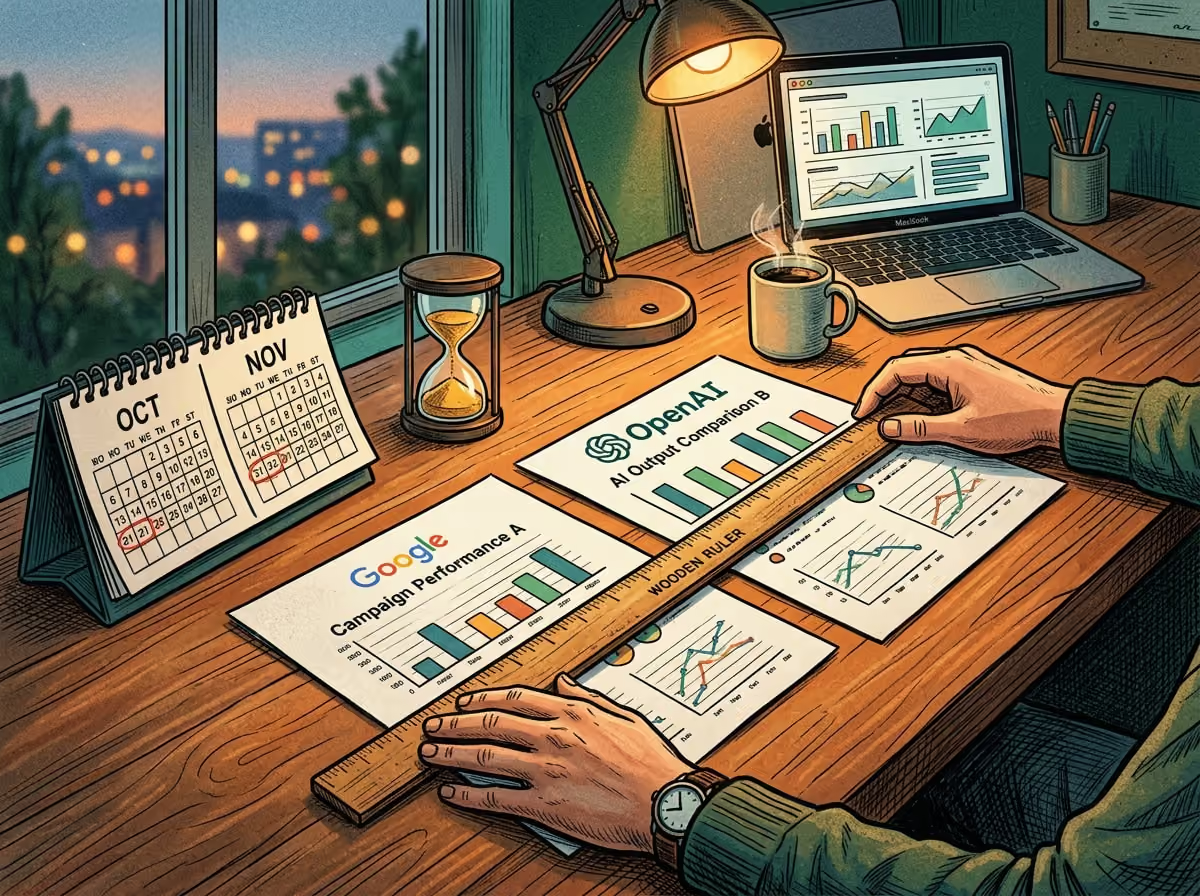
None of this means you should ignore the channel. It means you should test it like a skeptic. If someone on your team is asked to shift search spend based on a per-dollar figure built from another company's click costs, here's the setup I'd insist on first.
Compare like with like
The only comparison that means anything starts with your own spend and your own attributed revenue on each channel, over the same time period, with the same attribution settings. Not a benchmark from a press release, and not last quarter's Google numbers against this month's ChatGPT test. If your search CPA is already creeping up, sort that out on its own terms first. Our checklist for high CPA diagnostics is a good place to start, because moving budget away from a leaky funnel just moves the leak.
Put session counts next to every revenue number
In the paper, only 18 of 102 sites recorded any transactions from ChatGPT ads. A zero from a tiny test doesn't tell you the channel is weak. It might just tell you the test was too small. When you report results to stakeholders, show how many sessions each campaign drove right beside the revenue. A zero across 40 visits and a zero across 4,000 visits are completely different stories.
Define a qualified lead the same way on both channels
If you're in lead gen, agree on one definition of a qualified lead before the test starts, and apply it to both channels. Then give those leads enough time to close. If your sales cycle is 90 days, a 30-day test can tell you about lead cost, but not customer cost. Cost per sign-up is even further from revenue than cost per customer, so treat it as an early signal, not a verdict.
Document your attribution settings before you compare anything
This is where I see the most self-inflicted confusion. According to OpenAI's guide to measuring results, Ads Manager conversion totals can include eligible view-through conversions. Advertisers choose a 7, 14, or 30-day click window, and the view-through window can be set to one day or turned off. Both use last-touch logic. If your Google Ads account is set up differently, you're comparing two different rulebooks.
Expect clicks and sessions not to match
Ads Manager counts clicks. Your analytics counts sessions. Those numbers will drift apart. OpenAI notes that ad-review crawlers can visit landing pages with tracking parameters attached, and your analytics tool may log those visits as paid traffic even though nobody was billed. Redirects, consent banners, and browser-based blocking widen the gap further. Any per-dollar calculation that assumes one click equals one session is resting on a shaky foundation. If you've ever had two agencies reporting conflicting numbers for the same campaign, you'll recognize the pattern from the multi-agency marketing trap.
- Same window: run both channels over the same dates.
- Same attribution: match click windows and decide how you'll treat view-through conversions.
- Same definitions: one definition of a qualified lead or a transaction for both.
- Volume in the report: sessions and clicks sit next to every revenue figure.
- Patience: leave enough time for leads to become customers before you call it.
- A parity number: calculate your own break-even ChatGPT CPC from your own search data.
The Questions Nobody Can Answer Yet
There are a few things I'd love to know that simply aren't public yet.
First, there's no benchmark for what a "normal" ChatGPT click costs. OpenAI's ads FAQ says it doesn't currently provide performance benchmarks. The help pages suggest a starting bid, but none of them share what advertisers are actually paying. Every agency CPC above is specific to that one case.
Second, the paper doesn't break results down by month or by bid type. OpenAI added conversion-optimized campaigns in June, and nobody can tell from this data whether that changed outcomes. The data also stops before this month's bidding changes took effect.
Third, Google isn't sharing much either. In late October, Google said click-through rates for sponsored and organic product listings in AI Mode were similar, based on two weeks of internal U.S. data, but gave no actual rates. That's the only performance figure I've found for AI Mode ads.
So on both sides, the AI ad surfaces are being sold with very little hard data. That's not a reason to avoid them. It's a reason to bring your own measurement. And it's a reminder that paid placement in AI answers is only one part of showing up there. If your brand isn't visible organically in these tools, I'd look at that too. I wrote about why in Your Brand Can Rank #1 on Google and Still Not Exist to ChatGPT.
The Bidding Changes You Need to Know About
If you're already running ChatGPT Ads, or about to start, the bidding options changed this month, and two of them didn't exist when the paper's data was collected. Here's the short version from OpenAI's bidding and pricing page:
| Date | What changed |
|---|---|
| November 9 | Target CPA became available for new conversion campaigns, and Target CPC for new click campaigns. Both are average cost goals, not hard caps. |
| November 9 | The no-target option, previously called Maximize Results, is now called Intelligent bidding. |
| November 18 | Values sent through the legacy API bid fields are treated as an average-cost target when creating a campaign or changing an ad group's bid type. |
| January 1, 2027 | Max Bid and Max CPC retire for existing campaigns. |
None of these options come with proof that performance will improve. They give the system more room to bid above or below your target in each auction, which can help or hurt depending on how good your conversion signals are.
📋
Do this now: for every fourth-quarter ChatGPT Ads result you report, write down the campaign objective, the bid strategy, and the attribution windows that produced it. When you look back next year, that note is how you'll know whether this year's numbers are even comparable to next year's.
If it helps to zoom out, this is the same lesson I keep coming back to in The Zero-Click Web. Clicks and traffic are easy to count. Revenue is what matters, and it's always harder to trace.
Here's where I've landed. I'm not telling anyone to stay away from ChatGPT Ads. The audience is enormous, the platform is improving fast, and the people who learn how it behaves early will have an edge. But I wouldn't move a single dollar out of a search program that's working based on someone else's click prices and a press release ratio. Carve out a test budget you can afford to lose, set it up so it can actually tell you something, and let your own numbers make the call. If the channel earns its place in your mix, you'll see it. If it doesn't, you'll know that too, and you'll have saved yourself an expensive lesson.
