


SEO / GEO / LLM
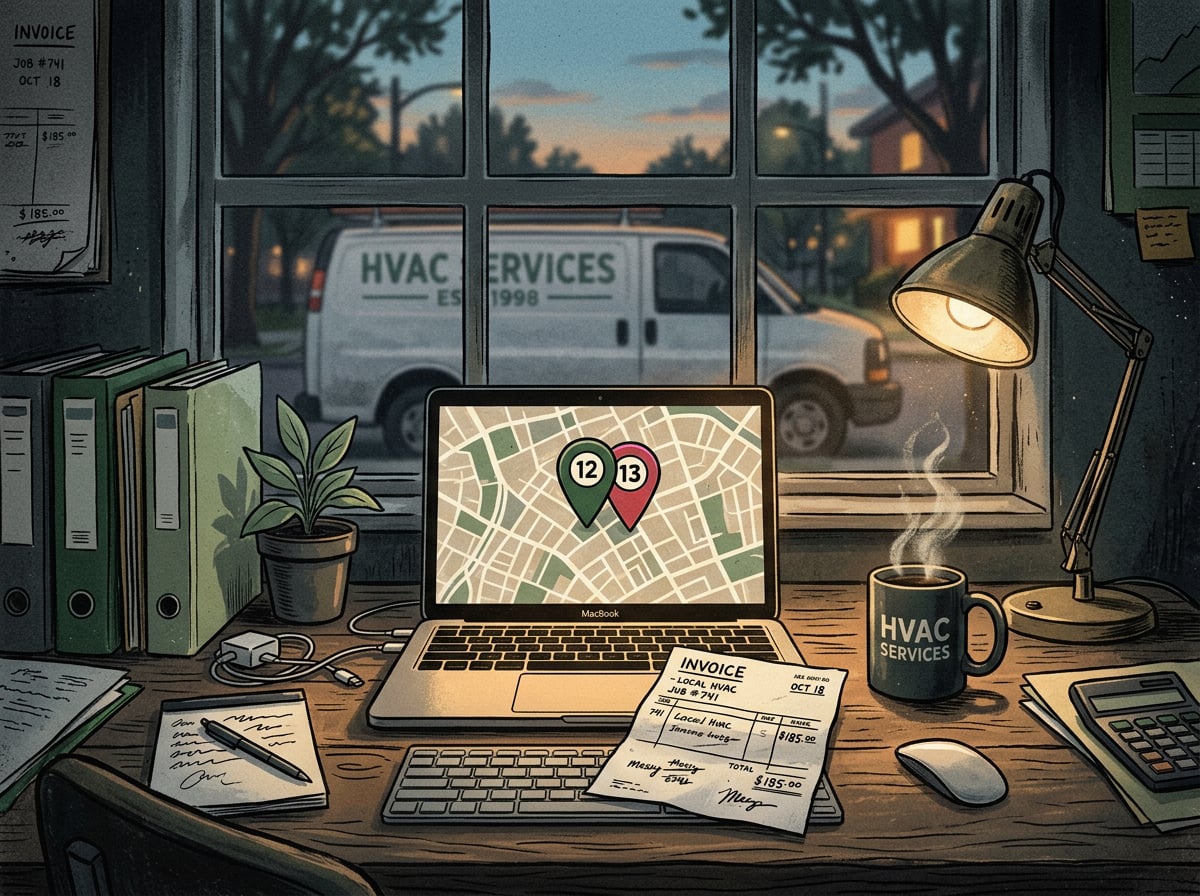
A few years ago I got a call from a guy named Marcus who ran a three-truck HVAC company outside Columbus. His numbers looked fine on paper, decent reviews, a real office, technicians who showed up on time, but he was getting buried on Google Maps by a competitor with worse ratings and half his experience. He was convinced someone was cheating. He wasn't entirely wrong, but not in the way he thought.
I drove out, sat in his conference room with a laptop, and pulled up his Google Business Profile. His listed address didn't match his actual office. He had two duplicate profiles from a directory listing company that folded years earlier. His hours said he closed at 5pm on days he actually ran emergency service until midnight. His primary category was "HVAC contractor" when half his revenue came from duct cleaning, a service he'd never told Google he offered. None of this was sabotage. It was neglect, and neglect is the single most underrated growth lever in local business.
That's the thing about local SEO right now. Everyone is panicking about how AI Overviews and answer engines are eating organic search traffic, and a lot of that panic is justified. But local search is different. It's the one channel where a language model can't fake proximity, can't fake a phone number that rings, can't fake a technician who actually shows up at your door in ninety minutes. Local SEO is still, mostly, a game of getting the boring details right and being the business that Google can most confidently vouch for. That's why I said it's stupid easy right now. Not because it takes no effort, but because almost nobody is doing the basics properly, which means the bar to beat them is embarrassingly low.
I put this checklist together after running it, literally, against dozens of client accounts. It's long because local SEO is genuinely made up of a hundred small decisions rather than one big strategy. I've grouped it the way we actually work through it with clients, and I've flagged the parts near the end that some agencies still quietly recommend that will get a listing suspended or a business fined. Skip those. They're not worth it anymore, and I'll show you why with actual numbers, not just a scolding.
Why Local Search Is Still the Fair Fight
Local intent searches, the "plumber near me" or "best tacos open now" kind, behave differently from broad informational searches. A 2025 consumer behavior study from Rio SEO found that a striking share of people now treat local search as a daily habit rather than an occasional lookup.
84%
of consumers search online for a local business every single day
Rio SEO, 2025 Local Search Consumer Behavior Study
75%
read at least four reviews before deciding who to call
Rio SEO, 2025 Local Search Consumer Behavior Study
60%
click into AI generated overviews when they appear in results
Rio SEO, 2025 Local Search Consumer Behavior Study
That last stat matters more than it looks. Even inside AI Overviews, the businesses that get surfaced for local queries are still pulled largely from the same signals that have always mattered: a healthy Google Business Profile, consistent citations, and a review profile that looks alive rather than abandoned. The interface changed. The underlying scoring didn't move nearly as much as people assume.
💡 Did you know?
Google has said publicly that around 30 percent of all mobile searches carry some kind of location intent, and that a large majority of people who search for something "near me" on a phone visit that business within a day. That gap between searching and showing up in person is exactly why local SEO converts so much faster than national campaigns.
Start With the Profile, Not the Website
If I could only fix one thing for a client, I'd fix the Google Business Profile before I touched a single line of their site's code. It's the first thing a searcher sees, and it's the piece Google treats as ground truth for "is this business real, open, and trustworthy right now."
Claim and verify it if you haven't. Use a real address that matches every other place your business is listed, down to whether you write "Street" or "St." Use a local phone number rather than a national call center line, since a mismatched area code is a small but real trust signal against you. Go find and merge or delete any duplicate listings, especially ones left behind by an old directory service or a previous owner. Pick the single most accurate primary category, since this is what Google leans on most heavily to decide which searches you're even eligible to show up for, then add as many of the nine allowed secondary categories as genuinely apply.
From there it's a matter of finishing the job most owners start and abandon: fill out every section of the profile, list actual products and services with real descriptions, upload a steady stream of high quality photos and short videos rather than one batch from the grand opening, set a proper cover photo and logo, and keep your hours accurate including holidays. Use Google Posts the way you'd use a small social feed. Answer every question in the Q&A section before a stranger does it for you with wrong information. Link to your correct, live website URL. And treat the whole profile as something you maintain monthly, not something you set up once and forget.
| Profile element | Why it actually matters | How often to check it |
|---|---|---|
| Primary + secondary categories | Largely determines which searches you're eligible to rank for at all | Every quarter, or after adding a new service |
| NAP consistency | Mismatches quietly erode Google's confidence in your listing | Every quarter |
| Photos and videos | Fresh visual content correlates with higher engagement and click-through in the map pack | Monthly |
| Hours, including holidays | Wrong hours are one of the top reasons customers leave a one-star review | Before every holiday season |
| Q&A section | Left unmanaged, competitors or trolls can post misleading answers | Weekly, or set up alerts |
Fix the Website Signals Google Actually Reads

Once the profile is clean, the website needs to say the same things in a different language. Your name, address, and phone number should appear on the site itself, ideally in the footer and on a dedicated contact or location page, and it should be marked up with LocalBusiness schema so Google doesn't have to guess what it's reading. If you serve multiple cities or neighborhoods, that dedicated location page becomes even more important, and it's worth embedding an actual Google Map rather than a static image.
Local keywords belong in the places search engines actually weigh, the title tag, the H1, the first paragraph, not stuffed awkwardly through the copy. Publish content that's genuinely specific to your service area rather than generic industry filler, since that's one of the few remaining ways a small local site can out-rank a national brand for a local query. If you serve more than a handful of towns or neighborhoods, we broke down how to structure that without it turning into thin, duplicate content in our piece on building a local content strategy for 100+ service areas. None of this matters if the site is slow or broken on mobile, so speed and mobile usability aren't optional extras, they're table stakes. Add clear calls to action, put testimonials and trust indicators where people can actually see them before they scroll past, and keep updating the content instead of letting the site sit untouched for two years.
We wrote a lot more about what's actually working in SEO right now, well beyond just schema, in our breakdown of the six brands quietly winning at SEO in 2026, and our rundown of the UX rules worth following is a good next read if usability is the part you're behind on.
💡 Did you know?
LocalBusiness schema doesn't directly boost your ranking on its own. What it does is remove ambiguity, giving Google a structured, machine-readable version of the same facts your GBP already claims. When the two match exactly, it reinforces the confidence signal instead of creating conflicting data for the algorithm to sort out.
The Review Flywheel
Marcus, the HVAC guy from earlier, had good reviews but almost none from the last six months. That gap mattered more than the star rating itself. Recency is one of the most underrated factors in how consumers, and increasingly the algorithm, judge whether a business is still actively good, not just historically good.
The system that actually works is simpler than most agencies make it sound. Ask for reviews as a normal part of finishing a job, not as an afterthought buried in an invoice email. Make it genuinely easy, a QR code on the receipt, a short link, a text message sent while the memory is still fresh. Respond to every review, good and bad, because the response is often read by more prospective customers than the review itself. Let real, specific language show up naturally in the reviews people leave, the actual service name, the actual neighborhood, without ever scripting it for them. And keep an eye on your reputation beyond Google alone, since Yelp, industry-specific platforms, and even Facebook reviews still shape a meaningful slice of buying decisions.
Step 1
Ask
Right after the job
→
Step 2
Make It Easy
QR code, one tap link
→
Step 3
Respond
To every review
→
Step 4
Monitor
Beyond Google alone
Step 5 · then loop back to step 1
Repeat, every single job
Citations, Consistency, and the Boring Stuff That Still Works
Citations, meaning any mention of your business name, address, and phone number across the web, don't carry the weight they did a decade ago, but they haven't disappeared either. What's changed is that consistency matters more than volume. Start by auditing what's already out there. Old citations from a previous address or a former phone number actively work against you, so cleaning those up often does more good than building ten new ones.
| Where to prioritize | Why start here |
|---|---|
| Primary data aggregators (Data Axle, Foursquare, and similar) | These feed your business data downstream into dozens of smaller directories automatically |
| Major map and directory platforms (Apple Maps, Bing Places, Yelp) | Apple Maps usage in particular has been climbing as an alternative to Google |
| Niche and industry-specific directories | Lower volume, but often higher trust and better qualified referral traffic |
| Local chamber and community listings | Signals genuine local presence in a way national directories can't replicate |
Local Links Are Still Just Links
Local link building doesn't need to be complicated or aggressive. Getting mentioned with your NAP intact on a local news site, sponsoring a youth league or a community event, earning a bit of local press coverage, contributing something genuinely useful that other local sites want to reference, all of that still works, partly because the local backlink landscape is far less saturated and far less policed than the national one. An award or a chamber membership that comes with a natural, unpaid link is worth more than it looks on paper, mostly because it's the kind of link a competitor genuinely can't fake or buy in bulk.
Behavioral Signals: The Part Everyone Forgets
Rankings aren't only about what you tell Google, they're increasingly shaped by what real people do once they find you. Fill out your title tags and meta descriptions properly instead of letting a CMS auto-generate them. Make sure the actual experience of using your site and profile is decent, not painful. Turn on every clickable action available on your Google profile, calls, directions, booking. If Google's reservation or appointment features apply to your industry, use them, since they shorten the path from search to conversion in a way that search engines notice. Keep an eye on your behavioral metrics in Google Analytics and Search Console, not just your ranking position, and don't underestimate the value of branded searches and direct traffic, whether that comes from paid ads, a strong reputation, or simply being the name people remember. If you want the wider picture on how search behavior itself is shifting, our AI Search Trends 2026 report breaks down what's changing across the board.
Tracking, Reporting, and Staying Current
Use dedicated rank tracking software rather than relying on your own occasional searches, since personalization and location will skew what you see. Google Business Profile Insights is worth glancing at but shouldn't be your main source of truth, the data is often too vague to act on directly. Pull your reviews and mentions into a single dashboard if you're managing more than one location. Set up Google Search Console properly and actually look at it. Build a regular reporting cadence, monthly at minimum, and stay reasonably current on algorithm changes, because local search updates roll out quietly and often without an announcement.
The Grey Hat Menu (And Why We Won't Serve It)
Every checklist like this eventually runs into a list of shortcuts that used to work: stuffing keywords into your Google Business Profile name, manipulating click-through rate by resetting your IP and searching your own keyword, buying links from a private blog network, spinning up fake or duplicate location listings, planting fake reviews or hitting a competitor with negative ones, embedding fake geo-tags in photo EXIF data, or using a VPN to fake being in a city you're not actually in.
I'm not going to pretend none of this ever worked. Some of it did, for a while, for some businesses. But the cost-benefit has flipped hard in the last couple of years, and it's worth understanding exactly why before anyone talks you into it.
⚠️ Did you know?
In the United States, the FTC's rule against fake or paid reviews now carries penalties of up to roughly fifty-one thousand dollars per violation, and it applies whether a business wrote the fake reviews itself or simply paid someone else to. Google has separately confirmed it blocks millions of fake reviews annually and now displays public warning labels on business profiles caught manipulating their reputation, sometimes blocking new reviews entirely for a set period.
Regulators aren't only chasing individual businesses either. The UK's Competition and Markets Authority estimated that as much as twenty-three billion pounds of annual consumer spending is influenced by online reviews, and found that the vast majority of consumers, around 89 percent, actually rely on them when researching a purchase. That's exactly why Google agreed to delete repeat offenders' reviews entirely and ban them from posting again, regardless of where they're located. When the potential downside is a public warning label on your own listing, a multi-month freeze on new reviews, or a five-figure fine per incident, the math on keyword-stuffing a business name or running a PBN just doesn't work anymore, even before you factor in the reputational damage of getting caught.
Everything on that grey hat list is a bet that Google's detection stays dumb forever. It hasn't, and the businesses I've seen get burned by it usually spent more cleaning up the mess than they would have spent just doing the checklist properly the first time.
Back to Marcus
We didn't do anything clever for Marcus. We fixed his address, merged his duplicate listings, corrected his categories and hours, built out a real photo library, and put a simple system in place so his technicians asked every single customer for a review before they left the driveway. Within four months he was outranking the competitor he'd called me about, not because we found a loophole, but because we made his listing the most obviously trustworthy one in a five mile radius. That's the whole game. It's just that almost nobody plays it consistently, which is exactly why there's still so much room to win at it.
If your local presence feels like it's stuck for reasons you can't quite explain, there's a good chance it's one of the boring items on this list, not a mystery algorithm penalty. Start there before you start anywhere else.
