


Growth Marketing
A client asked me something last month that I did not have a great answer for at the time. She wanted to know which page on her site to invest in first if the goal was showing up more in ChatGPT. Blog content? A better FAQ page? A redesigned product page? I gave her my best guess based on pattern matching from other accounts I run. Then WebFX published a study that actually answers the question with real data, and it turns out my guess was only half right.
WebFX pulled nearly 600,000 AI referral sessions across 2,500 URLs spanning more than fifteen industries, then broke every single one of those sessions down by page type, funnel stage, and content characteristics. This is not a survey where people report what they think is happening. This is actual referral traffic, measured, categorized, and sliced in a way that finally gives the rest of us something real to plan around instead of vibes and screenshots of one ChatGPT answer.
I want to walk through what the data actually shows, because a few of the findings genuinely surprised me, and one in particular should change how you prioritize your next quarter of content work.
The Page That Wins the Most AI Traffic Isn't What Most Teams Are Optimizing
Here is the finding that reframed everything else for me. Homepages captured 31.3% of all AI referral traffic in the study, more than any other single page type by a wide margin. Product pages came in second at 16.8%, then service pages at 11.4%, blog articles at 11.3%, and FAQ or resource pages at 7.2%. Together, those five page types accounted for more than two-thirds of all AI traffic in the entire dataset.
Share of AI referral sessions by page type. Source: WebFX, "What 600,000 AI Sessions Reveal About the Content That Wins AI Traffic", based on referral data from May 2025 to May 2026.
Think about why that makes sense once you see it. People are not asking AI to slowly walk them through ten blue links anymore. They are asking it to just tell them who the best option is. Once ChatGPT decides your business is a good answer, the homepage is where it sends someone to confirm that decision. I tested this myself by asking ChatGPT for the best AC repair company in a random Pennsylvania town, and every single recommendation pointed straight to a homepage, not a service page buried three clicks deep.
🏠
Why This Matters
If your homepage still reads like a generic "welcome to our company" placeholder, you are losing the single biggest AI traffic opportunity on your entire site. The homepage's job in AI search is to instantly confirm who you are, who you serve, and why someone should trust you, in the first few seconds someone lands there after an AI recommendation.
AI Traffic Is Not Top-of-Funnel. It's the Opposite.
This is the part of the study that genuinely reset my thinking. A lot of teams still treat AI search like a discovery channel, something you optimize with broad educational blog content the same way you would for early-funnel SEO. The data says that instinct is backwards.
Decision-stage content accounted for 55.3% of all AI traffic. Consideration-stage content added another 36.7%. Combined, 92% of every AI referral session in the study landed on a page built to help someone compare, evaluate, or decide, not a page built to introduce a topic to a total beginner. Awareness content, the classic "what is X" blog post that most content calendars are stuffed with, generated just 2.3% of AI traffic.
Share of AI Traffic by Funnel Stage
Where 590,868 classified AI sessions landed, by buying-journey stage
Awareness
2.3%
Consideration
36.7%
DecisionLargest share
55.3%
Retention
4.8%
Other
0.8%
Share of AI traffic by content funnel stage. Source: WebFX, based on 590,868 classified AI sessions.

Flip the usual funnel logic: AI search sends the most traffic to the bottom, not the top.
The content intent numbers tell the exact same story from a different angle. Nearly 7 in 10 AI sessions in the study, 68.9%, landed on transactional content. Informational pages accounted for just 18%. If you have been assuming AI search behaves like the top of a traditional funnel, this data is a pretty direct correction.
💡 Did You Know
WebFX's research also found that AI referral traffic converts about 1.2 times higher than traditional organic search traffic. Put those two findings together and the picture gets clearer: AI is increasingly acting like a pre-qualification layer, doing a chunk of the comparison shopping before a human ever lands on your site, then sending you visitors who are further along and more ready to act.
That has a real implication for where you spend your next content budget. The instinct to keep pumping out broad, awareness-level blog posts is understandable, but the data suggests the bigger opportunity right now is in the pages most teams treat as an afterthought: comparison pages, pricing resources, detailed FAQs, and service pages that actually answer the questions someone asks right before they buy.
Where AI Search Actually Diverges From Google
A natural question at this point is whether this just means "do good SEO" with extra steps. Not quite. The study also compared AI referral share against organic search share for the same page types, and the differences are where the real strategic opportunities show up.
| Page Type | AI Traffic Share | Organic Traffic Share | AI Lift vs. Organic |
|---|---|---|---|
| Blog / Articles | 11.3% | 4.0% | +7.3 pts |
| Product Pages | 16.8% | 9.7% | +7.1 pts |
| FAQ / Resource Pages | 7.2% | 1.9% | +5.3 pts |
| Service Pages | 11.4% | 10.9% | +0.5 pts |
| Homepage | 31.3% | 44.0% | -12.7 pts |
| Location Pages | 6.2% | 10.8% | -4.7 pts |
| Tools / Calculators | 3.4% | 6.4% | -3.0 pts |
"AI Lift" measures how much more (or less) of a page type's traffic comes from AI compared to organic search. Source: WebFX.
Blog articles, product pages, and FAQ or resource pages showed the biggest positive AI lift, meaning AI disproportionately favors them compared to how Google's organic results distribute traffic. That is genuinely good news if you have been on the fence about investing more in long-form content or a more thorough FAQ section, because the upside there is measurably bigger in AI search than it is in classic organic.
Meanwhile, homepages, location pages, and tools showed negative lift, meaning Google still leans on them more heavily than AI does, relatively speaking. That does not mean stop investing in local pages. It means understand that your local and branded visibility is still mostly a Google game, while your blog and product content have real headroom to grow specifically because of AI search.
Service pages landed almost dead center, with nearly identical shares across both channels. That is actually the most reassuring number in the whole study. A genuinely good service page pays off no matter which channel brings someone to it. If you have limited resources, service pages are one of the safest places to invest, because you are not betting on one discovery channel over another.
What Separates the Pages AI Actually Recommends
The most useful part of the report, in my opinion, is not the traffic distribution. It is the breakdown of what the highest-performing pages in the dataset had in common. WebFX scored pages on specificity and completeness, and the gap between the top performers and everyone else was stark. The best-performing pages averaged a 4.76 out of 5 on specificity and 4.15 out of 5 on completeness, meaningfully ahead of the rest of the dataset.
Specificity in that scoring means concrete facts, named entities, dates, statistics, real pricing, and actual product names, not vague category language. Completeness means the page does not stop at the first answer. It anticipates the next question, handles the obvious objection, and gives someone enough to act without bouncing back to Google or ChatGPT to keep researching.
This lines up almost exactly with something I have been saying for a while about how AI search evaluates content at the passage level rather than the page level. If you want the deeper mechanics of why that is, including how a single question gets broken into a dozen smaller ones before an AI system ever retrieves an answer, I went deep on that exact process in this piece on query fan-out and showing up when AI turns one question into a dozen. Specificity and completeness are essentially the raw materials that make a page winnable across all those sub-questions instead of just one.
The Content Playbook, Straight From the Data
Five patterns separated the highest AI-traffic pages from everything else in the dataset.
| What AI Rewards | The Evidence | What To Actually Do |
|---|---|---|
| A trusted homepage | Homepages generated 31.3% of all AI traffic, the single largest destination in the study | Make it a clear, confident introduction: who you serve, what makes you different, and why people trust you |
| Commercial depth | Product and service pages combined for 28.2% of AI traffic | Expand pages beyond basic descriptions into pricing, comparisons, and the questions people ask before buying |
| Decision support | 92% of AI traffic landed on consideration or decision-stage content | Invest in comparison pages, buyer's guides, pricing resources, and FAQs, not just top-of-funnel blog posts |
| Specific, complete answers | Top pages averaged 4.76/5 on specificity and 4.15/5 on completeness | Write around real facts, names, and numbers, then answer the follow-up questions before someone has to ask again |
| Demonstrated expertise | Pages with citations averaged 26% more AI traffic than pages without them | Add named authors, cite credible sources, and back claims with original data where you can |
That last row is worth sitting with for a second. More than two-thirds of the top-performing pages included expert credentials, and 52.6% featured original research or first-party data. Citations were not decoration on these pages. They were doing measurable work. A 26% average traffic lift from citations alone is a bigger swing than most individual SEO tactics manage on their own.
Your Product Pages Are Pulling More Weight Than You're Giving Them Credit For
Product pages capturing 16.8% of AI traffic, the second-largest share in the entire study, should change how a lot of ecommerce and product-led teams think about their PDPs. A product page is not just a transaction point anymore. Increasingly, it is the place AI sends someone after it has already decided your product is worth a look.
That puts even more weight behind something I have been harping on with clients for months: a product page that is technically complete but has no real point of view will still underperform, whether the visitor arrives from Google or from ChatGPT. If AI is sending you a visitor who has already narrowed their options and just needs confirmation, a page full of generic bullet points and a five-star badge with no context is not going to close the gap. I broke down exactly what separates a page that converts that kind of visitor from one that does not in this piece on why your PDP isn't missing proof, it's missing a point of view. The specificity and completeness scores WebFX measured here are really just a data-backed version of the same argument: generic content loses, specific and complete content wins, regardless of which channel sends the visitor.
📦
A Quick Gut Check
Pull up your top three product or service pages right now. Do they name specific outcomes, real pricing, and concrete details a shopper could not get from a competitor's near-identical page? Or would an AI system reading it come away with nothing more specific than "this is a good product"? That gap is exactly where the 26% citation lift and the 4.76 specificity score are coming from.
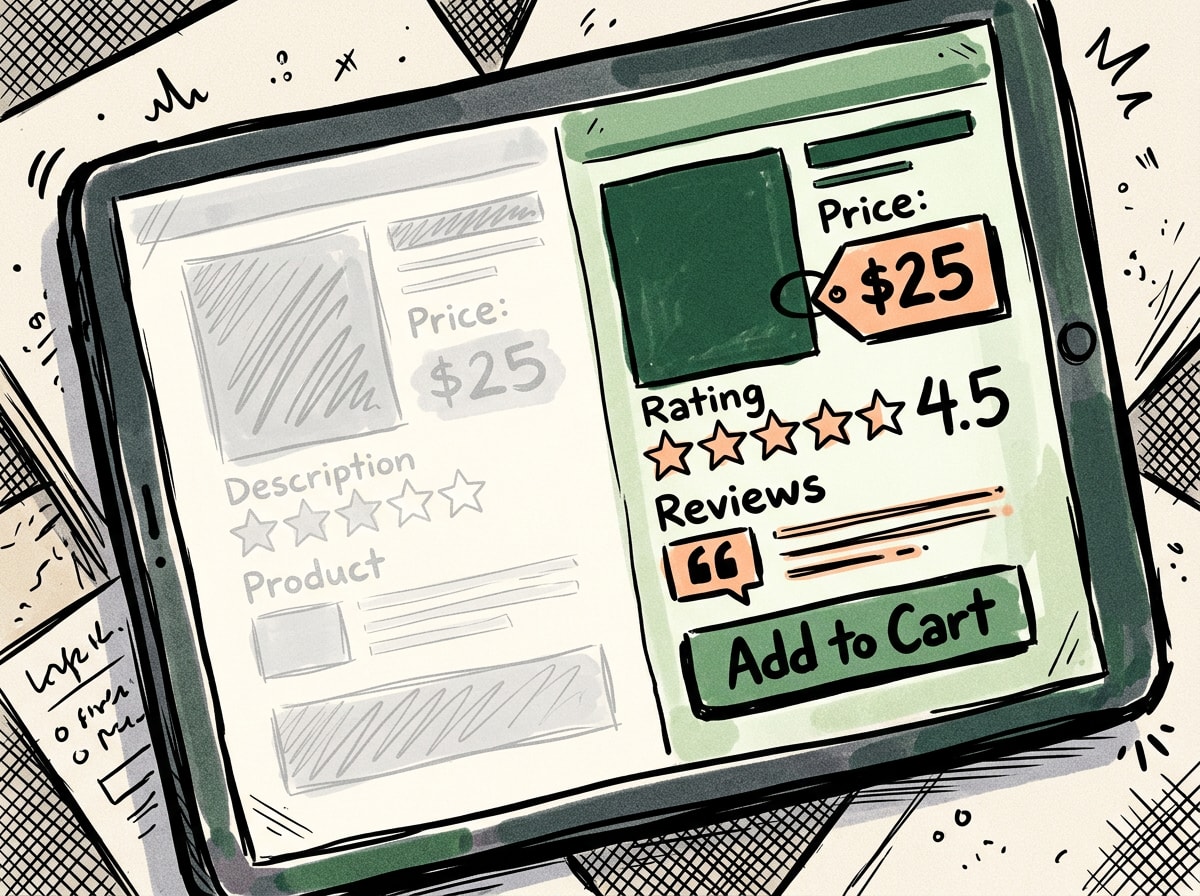
Same layout, two very different outcomes. Specificity is what AI actually reads as trustworthy.
A Word of Caution on Volume
It would be easy to read this study and conclude the answer is simply publishing more pages across all five of these categories as fast as possible. That would be the wrong takeaway, and honestly it is the same mistake I keep seeing brands make when they try to scale content production without scaling the actual substance behind it.
The specificity and completeness scores in this study are not something you can fake by publishing volume. A hundred thin product pages will not out-earn ten genuinely thorough ones. If anything, the pattern in this data mirrors something we have already seen play out at scale in traditional search, where AI-generated content pushed out fast and thin eventually collapses under its own lack of substance. I covered exactly how that collapse happens, and why it is a resourcing problem as much as a quality problem, in this breakdown of why scaled AI content keeps collapsing in Google. The mechanism is different between classic indexing and AI referral traffic, but the underlying lesson is identical: depth beats volume, every time the data actually gets measured.
One Platform Is Still Doing Almost All the Work
One more finding worth flagging before you build a whole strategy around this: ChatGPT accounted for 97.5% of all AI referral traffic in the dataset. Gemini, Perplexity, Claude, and Copilot made up the remaining sliver combined. That is not a reason to ignore the other platforms entirely, but it is a reason to be honest about where the actual traffic is coming from right now rather than spreading effort evenly across five platforms based on hype instead of data.
💡 Did You Know
Even within that small non-ChatGPT slice, early patterns are already showing up. Perplexity sends a relatively larger share of its traffic to blog content specifically, while Gemini appears to over-index on tools, calculators, and homepages. The volumes are still too small to build a platform-specific strategy around, but they are worth watching as adoption on those platforms grows.
What I'd Actually Prioritize Based on This
If I were sitting down with a client this week and using this data to set priorities for the next quarter, here is the order I would work through it in.
- Audit the homepage first. It captures the single largest share of AI traffic in the study. If it does not instantly answer who you are, who you serve, and why someone should trust you, fix that before touching anything else.
- Add real depth to your top product and service pages. Pricing, comparisons, implementation details, and the exact questions someone asks right before buying. Specificity is measurably rewarded.
- Build out decision-stage content deliberately. Comparison pages, buyer's guides, and detailed FAQs, since 92% of AI traffic in this study landed on exactly that kind of content.
- Add citations and named expertise wherever you can back a claim. The 26% average lift from citations alone makes this one of the highest-leverage, lowest-cost changes available.
- Resist the urge to scale by volume. A handful of genuinely complete, specific pages will outperform a large batch of thin ones, in AI search just as much as in traditional search.
None of this requires reinventing your content strategy from scratch. It requires taking a hard look at the pages you already have and being honest about whether they would survive the kind of specificity and completeness scoring WebFX used here, or whether they are coasting on being technically present without actually being useful.
What I Keep Coming Back To
The thing I appreciate about a study like this is that it replaces a lot of guessing with an actual number. For months, plenty of smart people, myself included, have been making educated guesses about what AI search rewards based on a handful of anecdotal examples. Six hundred thousand sessions is not anecdotal. It is a genuinely large enough sample to start planning against.
🎯
Where I Land On This
None of this is really new advice dressed up in new packaging. Be specific. Be complete. Back up what you say. Make your homepage actually explain who you are. What is new is having real data confirming that these unglamorous fundamentals are exactly what is winning AI traffic right now, at a scale nobody was measuring even a year ago.
If your content strategy still treats AI search as a mystery box, this study is about as close to a map as anyone has published so far. Start with the homepage. Give your product and service pages the depth they deserve. Build the decision-stage content most teams keep pushing to next quarter. That is where the traffic actually is.
