


SEO / GEO / LLM
I've sat in enough client calls this year to lose count of how many times someone has asked me some version of the same question. Can we just have AI handle our SEO now? And I get why people are asking. Every week there's a new tool promising to write, publish, and rank content on autopilot while you sleep. I've tested a bunch of them, both on our own properties and for clients who wanted to see what the hype was actually worth. Here is the honest answer after all that testing. Most of it does not work, at least not the way it's being sold to you.
The data backs this up more than I expected it to. AI Overviews now show up on a large share of Google searches, and when one appears, the click-through rate for the first organic result can drop by roughly a third or more, depending on the study you look at, with some datasets showing declines north of 50% for certain query types, according to research compiled by The SEO Works. A separate analysis covered by Forbes put the share of search results pages now showing an AI Overview at more than half. That is the backdrop every one of us is publishing into right now. Traffic is harder to earn than it was two years ago, and throwing more AI-written pages at the problem tends to make it worse, not better.
But I don't think the answer is to avoid AI either. I use it constantly. Just not the way most of the "fire your agency" videos are telling you to. Below are the five ways I actually put AI to work on SEO, for our own content and for the brands we manage, along with the numbers that convinced me each one was worth doing.
1. Use AI to Find the Angle Everyone Else Is Missing, Not to Publish More of the Same Thing
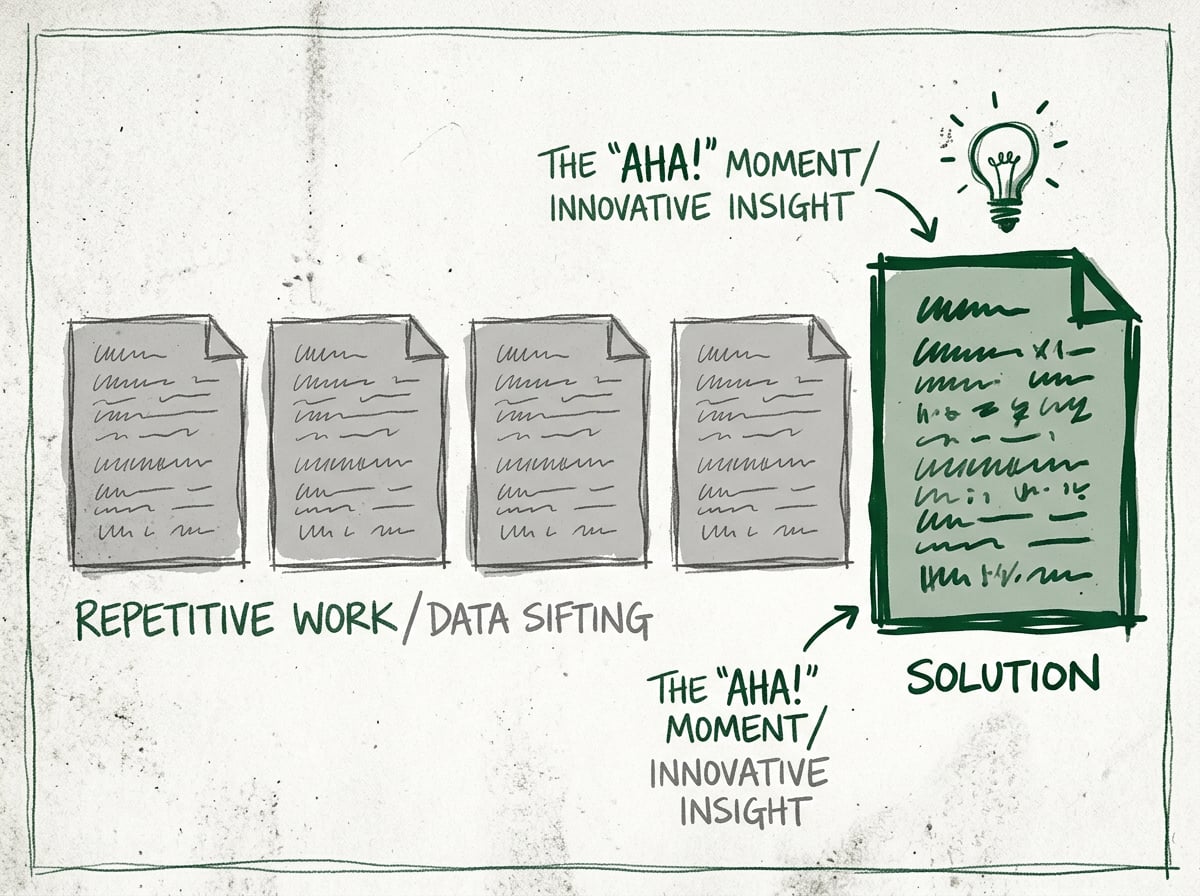
When everyone's content looks the same, the one piece with an actual point of view is the one that gets noticed.
The biggest mistake I see, and I mean this is the one that comes up in nearly every audit we run, is using AI to crank out volume. Yes, you can publish five hundred articles this month with a few prompts. The problem is that five hundred other people are publishing the same articles with the same prompts. If everyone's content reads the same, Google has no reason to send traffic to yours specifically, and neither does a reader.
We wrote about this exact pattern recently. If you want the fuller breakdown of why mass-produced AI content tends to rank for a few weeks and then quietly disappear, I'd point you to our piece on why scaled AI content keeps collapsing in Google. The short version is that volume without a genuine point of view is not a strategy, it's a liability waiting to show up in your crawl data.
Here is what I do instead. When we already have a page that performs, I'll drop the whole thing into Claude or ChatGPT and ask it directly: what is missing here, what would make this more useful than the top three results right now. It almost never says "add more words." It says things like "go deeper on the specific mechanism," or "add a real example," or "you're missing the counterargument." That is the kind of feedback that actually improves a page's odds, because it is pointing at a gap in the substance, not the word count.
💡 Did You Know
AI Overviews now show up on a growing share of Google search pages, and the presence of one alone can cut clicks to the first organic result by roughly 30 to 55%, depending on query type and device, according to data aggregated by The SEO Works. That gap is exactly why generic, easily-replicated content has become so much harder to win with. There simply are not enough clicks left over for content that does not earn its spot.
The other habit I've built is never accepting the first draft AI gives me as the final structure. I treat the model as a very fast research assistant, not a writer. It's good at surfacing what I might be missing. It is not good at deciding what my brand's actual point of view should be. That part still has to come from me, or from whoever on the team actually knows the subject.
2. Turn Whatever Data You Already Have Into Content Worth Linking To
Data-driven content still works, arguably better now than it did before AI flooded the internet with opinion pieces that all sound alike. Original research and proprietary data are things a model cannot generate on its own, which makes them one of the few remaining ways to stand out in a sea of AI-written summaries.
This is where I actually think AI earns its keep the most. Instead of manually digging through survey results, product usage data, or research reports looking for an angle, I'll feed the raw data into Claude and ask a simple question: what's surprising in here, what would make someone stop scrolling. It routinely surfaces a pattern I would have missed on my own, or at least would have taken hours longer to find. From there, the job is building content around that one interesting tension, not around the dataset in general.
📋 Why Data-Backed Content Earns More Links
| Content Type | What the Data Shows |
|---|---|
| Original research / proprietary data | Consistently cited as the top-performing format for earning referring domains, because other publishers need a source to point to |
| Interactive tools & calculators | Continue attracting links over time as new articles reference them, unlike standard posts that earn most links in the first few weeks and then plateau, per Fractl |
| Static "list of stats" content | Gets outranked over time by content that adds analysis and context around the same numbers, not just the numbers themselves |
A real example from our own work: we've used this approach to help a client turn a single internal survey into a research piece that ended up earning coverage from outlets well outside their usual reach. The AI's job in that process was narrow and specific. It helped us draft survey questions, spot the interesting gap in the responses, and suggest a few possible headline angles. We picked the one that actually mattered and built the story around it ourselves. If you want to see how this same logic applies to earning outside coverage more broadly, we go deeper on it in our post on why digital PR is the most underrated SEO strategy right now.
3. Stretch One Insight Into Ten Assets Instead of Writing Ten Separate Ideas
This one has nothing to do with generating more content from scratch. It's about getting more mileage out of what you've already built. Before AI, turning one good insight into a blog post, a newsletter section, three social posts, and a couple of visuals took most of a day. Now that same process takes maybe an hour, and the quality holds up fine because a person is still steering it.
The way I actually do this: I'll take a finding, a trend, or a client's own internal metric, and ask AI to summarize it in plain language, then draft short-form variations for whatever channels we're using that week. I never publish the first output verbatim. I edit every single one, because AI's default voice is smooth in a way that reads as nobody in particular. Editing it into something that sounds like an actual person is the part that takes the remaining effort, and it's the part that matters most.
✅
How I Actually Run This
Pick one insight your business already has, a stat, a survey finding, a customer pattern. Ask AI to draft a short explanation, a few social variations, and a simple visual concept. Rewrite every version in your own voice before it goes anywhere. The insight does the heavy lifting. The editing is what keeps it from sounding like everyone else's AI output.
4. Fix Click-Through Rate Before You Obsess Over Rankings

Clicks fall off fast after position one. Ranking well and getting clicked are two different problems.
People sleep on CTR way more than they should. It's a huge factor in how much traffic you actually see from a given ranking, and I've watched pages climb in position simply because they started earning more clicks than a typical page in that spot would. The ranking curve has also gotten steeper and stranger since AI Overviews became common, which makes getting this right even more valuable.
📋 Average Organic CTR by Google Position
| Position | Approx. CTR |
|---|---|
| 1 | ~25% to 40% |
| 2 | ~13% to 19% |
| 3 | ~9% to 12% |
| 4 to 10 | Drops off sharply, single digits by position 5 |
Ranges reflect variance across multiple 2026 datasets, including First Page Sage and Backlinko-style clickstream analyses. The spread exists because methodology, device, and query type all shift the numbers meaningfully.
What's changed the curve even more is what happens when an AI Overview shows up on the same page. Multiple 2026 studies point the same direction here, position 1 can lose somewhere between 30% and 55% of its expected clicks once an AI Overview appears above it, and overall zero-click search behavior, where a searcher never visits any website at all, is now estimated at somewhere around 60% of queries, based on data compiled through Forbes' coverage of the Stackmatix research. That is a huge chunk of demand that used to land on someone's website and now just doesn't.
Here's how I actually use AI against this problem. Once a piece is finished, I don't settle for one title tag anymore. I'll drop the article into Claude and ask for ten title tag variations optimized for clicks, not just keywords, some curiosity-driven, some benefit-led, some just plainly specific. Then I pick the one that fits based on judgment, not just whatever tested best in a vacuum. I do the same thing with underperforming pages. Export the Search Console data, upload it, and ask which pages have high impressions but weak CTR. It surfaces the underperformers in minutes and usually has a decent instinct for what the title is missing.
If your traffic has been sliding even while your rankings look stable, this is worth checking first, before you assume something is wrong with the content itself. We broke down a related pattern, where rankings hold steady but the actual query being served changes underneath you, in our piece on query fanout and why SEO traffic drops even when rank tracking looks fine.
⚠️
Worth Checking
Before you assume a traffic drop means you lost rankings, pull your Search Console data and check impressions against clicks specifically for pages that sit near an AI Overview trigger. A flat ranking with a falling CTR is a completely different problem than an actual ranking loss, and it needs a different fix.
5. Build a Small Tool Instead of Another Article

Anyone can write another article. Building something people actually use takes a little more, and it pays off longer.
Anyone can write an article now. That's the whole problem AI created for content marketing. But building something interactive, even a simple one, still takes enough effort and judgment that most competitors won't bother matching it. And the link-building data on this is not close.
📋 Why Interactive Tools Earn More Durable Links
| Format | Link Behavior |
|---|---|
| Standard blog post | Earns most links in the first few weeks, then plateaus |
| Calculator / interactive tool | Keeps accumulating links for months or years as new content references it, per Fractl |
| Free utility (checker, generator, etc.) | Can compound into a very large volume of links over time, similar in kind to how Ahrefs' free backlink checker has earned well over a million backlinks, according to G2's research on linkable assets |
We've done this ourselves. A static list-style page is easy to copy and painful to maintain. Someone has to manually refresh the numbers every few months, and any competitor can rebuild the same list in an afternoon. Turn it into something dynamic instead, and two things happen at once. It becomes far less copyable, because the value is in the mechanism, not just the list, and it becomes far less work to maintain because it updates on its own.
The good news is you don't need a developer on staff to pull this off anymore. AI has made it realistic to prototype a calculator, checklist, or generator without writing most of the code yourself. It still takes more effort than a blog post. It also pays off in a way a blog post usually can't.
Where I'd Actually Point Your Time
If I had to rank these five for a client starting from zero, I'd tell them to fix CTR on existing pages first, since it's the fastest and lowest-effort win, then move into data-driven content, since it compounds the longest. Micro tools are worth building once you have the bandwidth, but they're a bigger lift and I wouldn't lead with them.
None of this replaces having a real strategy behind your content. AI speeds up execution. It does not replace the judgment of knowing what's actually worth writing about in the first place, or why a reader should trust your take over the next site's. That part is still on us. It always was.
If you want a second set of eyes on where your content is actually losing clicks versus where it's losing rankings, that's a conversation I have with clients weekly. Happy to have it with you too.
