


Growth Marketing
By Joey Rahimi
I've spent a good chunk of this year sitting inside ad accounts for DTC brands, and I keep running into the same wall. Teams are pumping out more creative than they ever have, and the numbers keep sliding anyway. Not because Meta broke something. Because most of that output is volume with no intent behind it.
If you're running paid social right now and you've watched your creative performance plateau or slide while your output has gone up, stick with me for a few minutes. I think I can save you some money.
The Real Problem Isn't Volume. It's Intent.
Here's the thing I keep saying to founders, and it never seems to land until they see it in their own account: brands are making more ads than ever, and their performance is worse than ever, because it's volume without intent.

That's the trap. A lot of teams I talk to mistake output for strategy. They hit their weekly ad quota, feel productive, then wonder why nothing is moving. But churning out forty variations of essentially the same idea, aimed at the same persona, with the same emotional angle, isn't testing. It's confirmation bias wearing a lab coat.
~7%
Average CTR lift from meaningful creative differentiation vs. shallow iterations
(WordStream)
(WordStream)
56%
Of ad creative performance driven by the creative itself, per Nielsen
1
Winning concept framework can scale a brand to 8 figures when iterated meaningfully across personas
I saw this play out with a brand I worked with that was under a million in ARR and ended up scaling to somewhere around $40 to $45 million. The creative engine behind that jump wasn't a hundred different ideas. It was one winning script concept, run through different vehicles: AI animation, an authority figure, a podcast style cut, a founder led version. One idea, expressed well through different formats for different audiences.
That should change how you think about what "volume" even means.
The takeaway
Before you brief your next batch of creative, ask yourself something honest: are these actually different concepts, or are we remixing the same idea because it's easier than doing the research to find a new one?
The Feed Has Changed. Most Brands Haven't Noticed.
Something I've watched shift hard over the last twelve months is how hyper relevant the Meta feed has become. It isn't demographic level targeting in any meaningful sense anymore. The algorithm is moving toward what I'd call micro persona delivery: matching people to content based on psychological intent and behavior, not broad audience buckets.
What that means in practice is that persona level creative, content built for a specific person in a specific mindset, has gone from a nice to have to table stakes. Generic ads trying to appeal to everyone get punished harder than ever, because the feed is now smart enough to serve them straight to the people least likely to respond.
Persona analysis, journey mapping, creative consumption analysis. These aren't nice to have anymore. They're the baseline requirement if you want ads that actually convert.
So what does this mean for you practically? It means your creative brief has to start with a specific human, not a product. Who is this person? What does their organic feed actually look like? What emotional state are they in when your ad shows up? What format do they trust?
💡 Did You Know
Research from LinkedIn's B2B Institute found that emotionally resonant creative outperforms rational messaging by 2:1 on brand recall. On Meta specifically, psychological relevance at the creative level now matters more than bid strategy or audience size for most mid market brands.
AI Video Is No Longer Experimental. It's a Creative Layer.
A year or two ago, AI animation was barely usable for direct response work. Now it's genuinely competing with, and sometimes beating, real human creators. I don't say that to sound impressed for the sake of it. I've watched the same pattern show up across multiple accounts.
The framework I use to explain this to clients is a four layer creative stack:
| Format Layer | Primary Use Case | Production Cost | Best For |
|---|---|---|---|
| Statics | Iterative messaging tests, headline experiments | Low | Early-funnel angle discovery |
| UGC / Yapper | Authenticity, trust-building, persona-matched content | Low-Medium | Problem-aware audiences |
| High Production | Brand storytelling, retargeting, retention | High | Warm audiences, brand lift |
| AI Video / Animation | Explainer concepts, character-driven narratives, scale testing | Low-Medium | Broad cold audiences, education |
Here's why AI animation isn't just a passing trend. There's a simple reason cartoons work so well as a learning format: people process a story or a message more easily through animated visuals than through a talking head on camera. Nothing new there, it's basically the whole logic behind explainer video, but applying it to direct response ads is still pretty underexplored.
What the sharper teams are doing is building actual characters and a persistent visual world around the brand inside the animation format, instead of one off executions. That matters for your budget too. If you build one clay character for your brand and run it across fifteen different scenes, you've just saved yourself the cost and time of generating fifteen separate visual concepts from nothing.
How the AI videographer role actually works
The setup that works best isn't training your existing editors on AI tools. It's hiring a specialist whose entire job is AI content production, sitting at the end of your existing creative strategy pipeline. Strategy and scripting stay with your strategist. Visual execution routes to the AI specialist. The constraint I recommend: keep scripts under a minute, and keep scenes per brief limited so production time doesn't balloon.
Yapper Ads: The Format Most Brands Are Getting Wrong
The shift toward what people are calling "yapper ads," unscripted or lightly scripted creator led content that mimics organic video, is real. Most brands are still executing it badly though.
The problem I keep seeing is that brands hear "make ugly ads" and land somewhere in the middle: too produced to feel real, but not polished enough to feel like intentional storytelling either. That middle ground is where ad performance goes to die.
Authentic, when it comes to a yapper ad, means something specific: it should feel indistinguishable from what your target person would naturally scroll past on their own feed. And that looks completely different depending on who you're talking to.
- A 22-year-old consumer seeing a supplement ad: someone in a gym, bad lighting, no captions, talking directly to camera
- A 45-year-old professional seeing a financial product: polished but unstaged, maybe in a home office, conversational not performative
- A luxury consumer: effortless, aspirational setting, zero hard sell, not "ugly" in any conventional sense

The brief advice I give my own creator teams is worth repeating here. For yapper ads, I don't hand over a full script. I give five hook variations and a set of talking points, then let the creator fill the gaps in their own voice. The less rigid the brief, the more the final product sounds like an actual person and not a brand pretending to sound like one.
📊 Did You Know
According to Edelman's Trust Barometer, trust in institutions and traditional advertising continues to decline, while peer recommendations and "people like me" remain the highest trust information sources. Creator led, conversational ad formats are a direct response to that structural trust gap, not just a trend.
The other underrated piece is creator sourcing. If your brief is great but your creator pool is three people who aren't remotely relatable to your target persona, the format won't work no matter what you write. I run a small sourcing operation whose only job is scrolling platforms to find and recruit creators who are naturally good at yapper style content. We test hundreds of them. The ones that convert graduate into retained relationships.
Pattern Recognition Over Production: Using AI in Strategy
One of the most useful things I've built into my own process is using AI for analysis, not execution. Specifically, running existing ad account creative through a tool that flags which psychological messaging zones you're actually speaking to, and where the gaps are.
I built a simple report that pulls video transcripts from an ad account and buckets the messaging into emotional categories: fear based, aspirational, problem aware, after state, and so on. The finding is almost always the same. Most brands are speaking nearly exclusively to fear and shame, because that's the easiest emotional trigger to write to, and it's completely saturated.
Pattern recognition at scale is one of my favorite uses for AI in strategy. Map all your creative across a matrix, then look for where the underserved personas or emotional zones are sitting. You'll find a bigger unlock there than you will from setting up a workflow that churns out 250 ads a week.
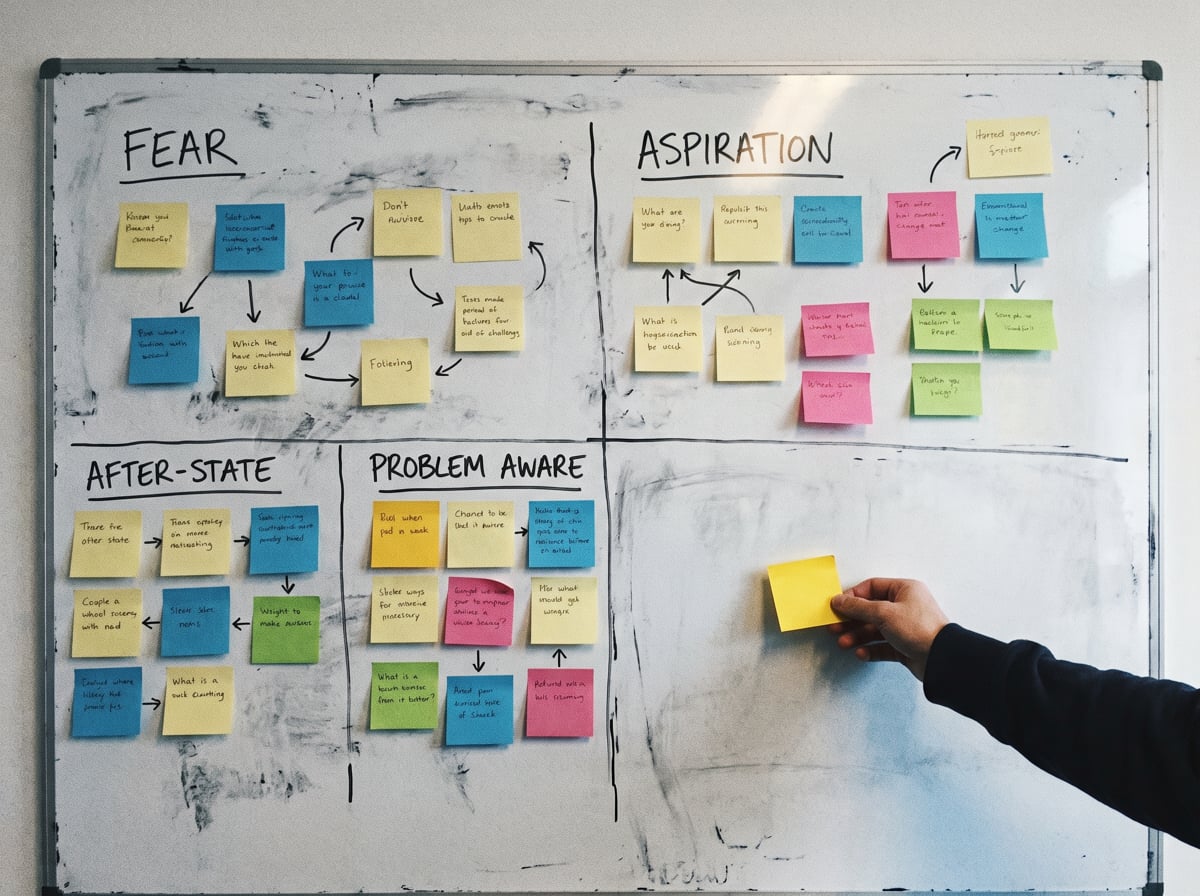
You can run a rough version of this yourself. Pull the last 30 ads your team has produced. Read the scripts. Ask yourself honestly what emotion each one is trying to trigger. Then put it in a simple table:
📋 Copyable: Creative Audit Table (HTML)
<table border="1" cellpadding="8" style="border-collapse:collapse;width:100%;font-family:sans-serif;">
<thead style="background:#0d3819;color:#fff;">
<tr>
<th>Ad Name</th>
<th>Format</th>
<th>Persona</th>
<th>Emotional Zone</th>
<th>Awareness Level</th>
</tr>
</thead>
<tbody>
<tr><td>Ad_001</td><td>UGC</td><td>Gym Bro</td><td>Fear / Shame</td><td>Problem Aware</td></tr>
<tr><td>Ad_002</td><td>Static</td><td>Gym Bro</td><td>Fear / Shame</td><td>Problem Aware</td></tr>
<tr><td>Ad_003</td><td>High Prod</td><td>Gym Bro</td><td>Aspiration</td><td>Solution Aware</td></tr>
</tbody>
</table>
If you fill that table in honestly for your last month of creative, the pattern usually shows up fast. Most brands are running 80% of their creative into one persona, at one awareness level, with one emotional tone. The fix isn't more volume. It's filling the empty cells.
The Iteration Debate: What Actually Changed After Andromeda
There's been a lot of noise in the DTC world since Meta updated its Andromeda creative ranking system, mostly people arguing about whether iterations still matter. My take is that they absolutely still work, they just need to be meaningful now.
The old playbook of swapping a text overlay or changing one B roll clip doesn't move the needle anymore. What actually works is changing the DNA of the ad while keeping the core concept intact. Different emotional framing. Different format. Different visual environment. Different hook mechanism.
| Iteration Type | Pre-Andromeda Value | Post-Andromeda Value | Recommended? |
|---|---|---|---|
| Text overlay change on hook | Medium | Low | Only early in concept testing |
| B-roll swap mid-ad | Medium | Very Low | Not as standalone iteration |
| Different format (UGC to AI animation) | High | High | Yes |
| Same framework, new persona script | High | High | Yes |
| Emotional reframe (fear to aspiration) | High | High | Yes |
| Hook mechanism change (pattern interrupt vs. direct) | High | High | Yes |
There's also a persona expansion play worth knowing. Once you have a winning script framework, don't just iterate on format. Take the same structural logic, adjust the hook and a handful of key lines to target a different persona, then run it fresh. I've done this for a brand where every single time we applied a proven framework to a new persona, it became a top spender. The reason is simple: the message mechanics are already validated. You're only changing the lens.
Watch out for confirmation bias in your data
One of the most expensive mistakes in creative strategy is going deeper and deeper into a persona that's already working, at the expense of ever discovering new ones. I audited a major supplement brand spending heavily on Meta and found them running almost exclusively to one audience. Their LTV data showed that persona was valuable, sure, but they had zero signal on newer, potentially higher value audiences because they'd never actually tested any. Always be watching for the low volume signals pointing toward your next persona.
Positive Framing: The Macro Creative Trend Nobody Is Acting On
This is the part I find most interesting when I look ahead. Fear, shame, and problem agitation have become so saturated as creative mechanisms that they're losing their edge, and there's a real cultural appetite building for something different.
The data backs this up. When you audit creative across most ad accounts, fear based and shame based messaging is almost always the overrepresented emotional category. It's the easiest tone to write in, and it does work. But when everyone is doing it, it stops cutting through the noise.
The alternative isn't naive positivity. It's shifting the frame from "here's the problem you have" to "here's who you become on the other side." Ideal self framing. After state storytelling. The emotional center of gravity moves from anxiety to aspiration, without losing specificity or urgency.
Practically, this shows up in two places:
- Script structure: Spend less time sitting in the problem and more time making the after state feel vivid and achievable. The hook can still reference the problem, but the emotional payoff should live in the transformation.
- Visual language: Show the person after, not the product. If you're selling a fitness supplement, don't open on a body that needs fixing. Open on a version of the viewer's best self doing something they actually want to do.
🧠 Did You Know
Research published in the Journal of Marketing has consistently found that aspirational, identity affirming messaging generates stronger brand loyalty and repeat purchase intent than problem centric messaging, particularly for lifestyle and wellness categories. Fear drives a first click. Identity drives retention.
Complexity Bias Is Killing Your Messaging
One last thing that I think is chronically underrated: brands write at a reading level way above where they need to be.
When you're close to a product or a problem space, you start assuming your audience shares your vocabulary. They don't. The person scrolling Instagram at 9pm, half watching TV, doesn't know what "visceral fat" means. They don't want to decode jargon. They need to know within two seconds whether this thing is relevant to them, in language they already use about themselves.
The test I use is simple. Take your script, paste it into Claude or any LLM, and ask it to rewrite for a 14 year old reading level. Then compare the two. The simpler version will almost always perform better on cold audiences, because it removes the cognitive friction that makes people scroll past.
Visual metaphors help too. If you're explaining something complex, show it instead of saying it. A gut health concept becomes immediately clear when you see a jug of water pouring out through holes rather than reading three sentences about intestinal permeability. The visual does the explaining in a fraction of the time, and it sticks better.
A simple messaging clarity test
Read your hook out loud. If it takes more than two seconds to understand what it's about and who it's for, rewrite it. Your ad is competing with everything else in a feed built to be endlessly scrollable. Clarity is a competitive advantage.
What to Actually Do With All This
If I were advising a brand running paid social today, here's where I'd start, based on everything above:
- Run a creative audit across your last 30 to 60 days of ads. Map every piece of creative to a persona, an emotional zone, and an awareness level. Find the gaps.
- Identify your one or two best performing frameworks. Apply those to a new persona before you create anything net new.
- Build a creator sourcing process, even a simple one. Don't rely on the same three people for yapper content. Breadth in creators is breadth in audience reach.
- Add AI animation as a deliberate creative layer, with a specialist producing it, not as a side project for an editor who's already stretched thin.
- Do at least some manual research for new brand projects. Scrape Reddit, sure. But also actually read the threads. The context around a mention tells you more than the mention itself.
- Run a reading age test on your top scripts. Simplify anything above a Grade 8 level for cold audiences.
None of this is complicated. Most of it is just doing the foundational work that gets skipped when teams are sprinting toward a weekly ad quota. The brands winning in 2026 aren't necessarily making more ads. They're making better decisions about which ads to make, and why.
