


SEO / GEO / LLM
Let me be honest with you. A year ago, when people talked about "AI in e-commerce," they mostly meant chatbots on product pages and AI-generated subject lines. It felt like the future. It felt distant.
It's not distant anymore.
I recently had the chance to sit in on a conversation between retention and e-commerce experts from Klaviyo, Goat Foods, and Flo Retention Marketing Agency about exactly this shift. What I heard was not hype. It was a pretty sober, grounded look at something that's already changing how consumers discover, evaluate, and buy products online. And it's changing fast enough that brands sitting on the sidelines are going to feel it before the year is out.
Here's what's actually happening, what it means for your retention strategy, and where to put your energy right now.
The Top of the Funnel Didn't Die. It Moved.
The biggest shift is not in conversion. It's not in email. It's happening at the very beginning of the customer journey, in the way people discover products in the first place.
People used to Google simple keywords. Someone needed sugar-free snacks. They'd type "sugar-free candy" into a search bar, scroll through results, click around, and eventually land somewhere. That process was linear, somewhat slow, and predictable. Brands could game it with SEO.
Now that same person opens ChatGPT and types: "My dad is diabetic but has a major sweet tooth. What are the best sugar-free candy gifts for Father's Day?" And they get an answer. A specific one. With a product recommendation. Possibly with a link to buy it.
The research phase, what marketers call "awareness and consideration," is increasingly happening inside a large language model rather than across ten browser tabs. And by the time someone lands on your website, they may have already made their decision.
What the data shows
↑ CVR
Traffic coming from AI platforms like ChatGPT and Perplexity is converting at higher rates than typical organic traffic, because users arrive with the consideration phase already complete. Source: industry data shared by Flo Retention Marketing Agency.
Less traffic, but higher intent. That's the trade-off brands are starting to notice. The people who find you through an AI agent are not browsing. They came to buy. They may not know your brand at all, but they trust the agent that pointed them your direction. That is a fundamentally different relationship than someone who found you through a Google ad or a sponsored Instagram post.
💡 The implication for acquisition
If your brand is not showing up in AI-generated product recommendations, you're effectively invisible to a growing segment of high-intent shoppers. The question is no longer "are people using AI to shop?" The question is "is my brand showing up when they do?"
What an AI-Ready Product Page Actually Looks Like
This is where things get practical. If an AI agent lands on your product page and your page cannot confidently answer whatever question a potential customer just asked, that agent is not going to fill in the gaps for you. It'll move on to a competitor whose page actually answers the question.
So what does an AI-ready PDP look like? It's not about aesthetics. It's about specificity and structure.
Think about a coffee brand as an example. The generic product description might say "smooth, rich blend perfect for mornings." That tells an AI agent almost nothing useful. The AI-ready version tells you the roast level, the origin, the recommended grind size, the brew methods it's suited for, and the flavor notes in actual sensory language. It answers the question "is this the right coffee for me?" without the customer having to ask a follow-up.
The metadata fields you're probably ignoring
Most brands have structured data fields in their e-commerce platform and never fill them in properly. These are exactly what AI agents pull from when constructing recommendations. Every product attribute you leave blank is a question an agent cannot answer on your behalf. Go fill them in.
| Old PDP Mindset | AI-Ready PDP Mindset |
|---|---|
| Marketing language and aspirational copy | Specific specs, use cases, and product attributes in structured fields |
| Generic "great for everyone" positioning | Clear description of who this product is best for and why |
| 3-5 star review average with short reviews | Detailed reviews that describe use cases, comparisons, and specific outcomes |
| FAQ section as an afterthought | FAQ built from real customer support tickets and common queries |
| Blog as a traffic and SEO play | Blog as a knowledge base designed to be cited by LLMs |
💬 Did You Know
According to BrightLocal's consumer research, 98% of consumers read online reviews for local businesses. As AI agents increasingly use review content to generate product recommendations, the quality and specificity of those reviews is becoming a critical ranking factor in AI-driven search, not just social proof for human readers.
Reviews Are No Longer Social Proof. They're Training Data.
This one stopped me when I first heard it, and I think it'll stop you too.
Reviews used to live in the retention bucket. You collected them to reassure the next buyer. They were social proof. Five stars and a nice comment made the brand look credible.
That's not how reviews function anymore. Today, reviews are product education. They are content that AI agents read, parse, and use to answer specific consumer questions. When someone asks ChatGPT "what's a good sugar-free candy for someone who's diabetic," the AI is not just reading product descriptions. It is reading individual reviews where someone mentioned being diabetic and loving the product. That one review, with that one specific detail, is what gets your brand into the conversation.
"They are not social proof anymore. They are product education."
This changes how you should be collecting reviews entirely. The standard "how was your experience, 1 to 5 stars" prompt is almost useless in this context. You need reviews that answer real customer questions. That means prompting for specificity.
- Why did you buy this product?
- Who was it for?
- What problem were you trying to solve?
- Did you compare us to another brand before buying?
- Who specifically would you recommend this to?
- What use case or occasion was this for?
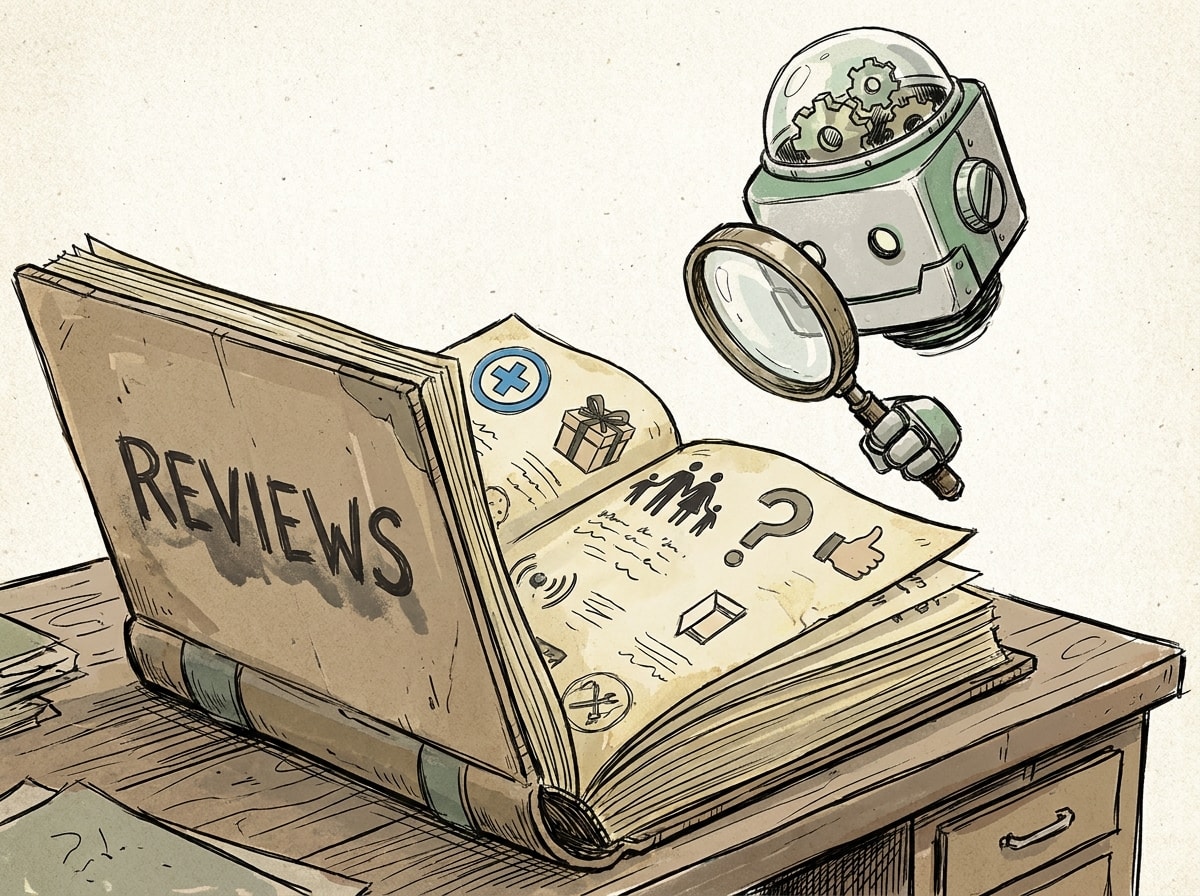
Google Maps has already figured this out. Reviews with 200 characters or more are weighted more heavily in their algorithm. The same principle applies to how LLMs parse and weight review content. Short, vague reviews contribute noise. Long, specific reviews contribute signal. And right now, that signal is feeding AI recommendations.
🎯 Retention marketers: this is your job now
Auditing and improving review collection strategy is increasingly a retention function, not just a CX or marketing ops task. If you run post-purchase flows, you are in the best position to collect these reviews at the right moment with the right prompts.
Content Strategy Has a New Job Description
SEO and AI optimization are related but not the same thing. The goal of SEO was to rank a page by satisfying algorithmic criteria: keyword density, backlinks, domain authority, structured data. The goal of AI optimization is to be cited. These are different objectives that require different approaches to content.
When someone asks an LLM a question, the model is looking for the clearest, most complete, most trustworthy answer available. It's not counting keywords. It's assessing whether your content actually answers the question being asked. That means:
FAQs built from real customer data outperform FAQs written by a marketing team. One approach the Flo team uses is an "abandoned cart follow-up" email that doesn't try to rescue the sale but instead asks what question the customer had about the product they didn't buy. The response rate is low, but the quality of the responses is extremely high. Those answers feed directly into the FAQ content that AI agents will reference.
Similarly, exporting historical help desk tickets and running them through an AI to identify the most common questions is a fast way to build out FAQ pages that are genuinely informed by what customers actually want to know. That kind of content gets cited by LLMs. Generic marketing copy does not.
🔍 Did You Know
According to Search Engine Land's analysis of AI search referral traffic, ChatGPT and other AI-powered search tools are driving increasingly significant referral traffic to e-commerce sites. Unlike traditional SEO, improvements to AI-visible content can show measurable results in weeks rather than months.
The blog post isn't what you think it is anymore
Here's something worth sitting with: your blog posts don't need CTAs anymore. They don't need to convert. They don't even need a lot of human readers landing on them directly.
What they need to do is exist on your domain as accurate, detailed, well-structured knowledge that an LLM can pull from when someone asks a question your brand could answer. The blog post that explains "what grind size you need for a French press" is not going to drive traffic to your coffee shop's homepage directly. But it might be the reason an AI recommends your brand when someone asks "what's the best coffee for a French press beginner."
⚠️ Watch out
Minimalism is hurting you. Long-scroll pages with detailed, specific content are outperforming short, visually clean pages in both AI visibility and human conversion. If you've been A/B testing short vs. long and the long pages keep winning, that's why.
When an AI-Referred Customer Lands on Your Site
Here is where the operational changes get specific. Customers arriving from AI-driven journeys behave differently than customers arriving from paid ads or email campaigns.
The behavioral signature looks like this: they often land directly on a product detail page as their first-session page, bypassing the homepage entirely. Their session is shorter than average. They're not browsing. They came to confirm and buy.
What that means for your welcome flow and opt-in strategy is that a generic 10% off popup is not the right tool for this moment. These customers are not price-sensitive browsers who need a nudge. They came with intent. What they often lack is trust in your brand, because they may have heard of you for the first time from the AI agent that recommended you.
| Customer Source | Typical Behavior | What They Need |
|---|---|---|
| Paid social (cold) | Lands on homepage or collection, browses widely, long session | Inspiration, social proof, introductory offer |
| Email / SMS (existing) | Lands on specific product or campaign page, moderate session | Personalized recommendations, loyalty recognition |
| AI agent referral (new) | Lands directly on PDP, short session, high purchase intent | Brand trust signals, social proof, not discounts |
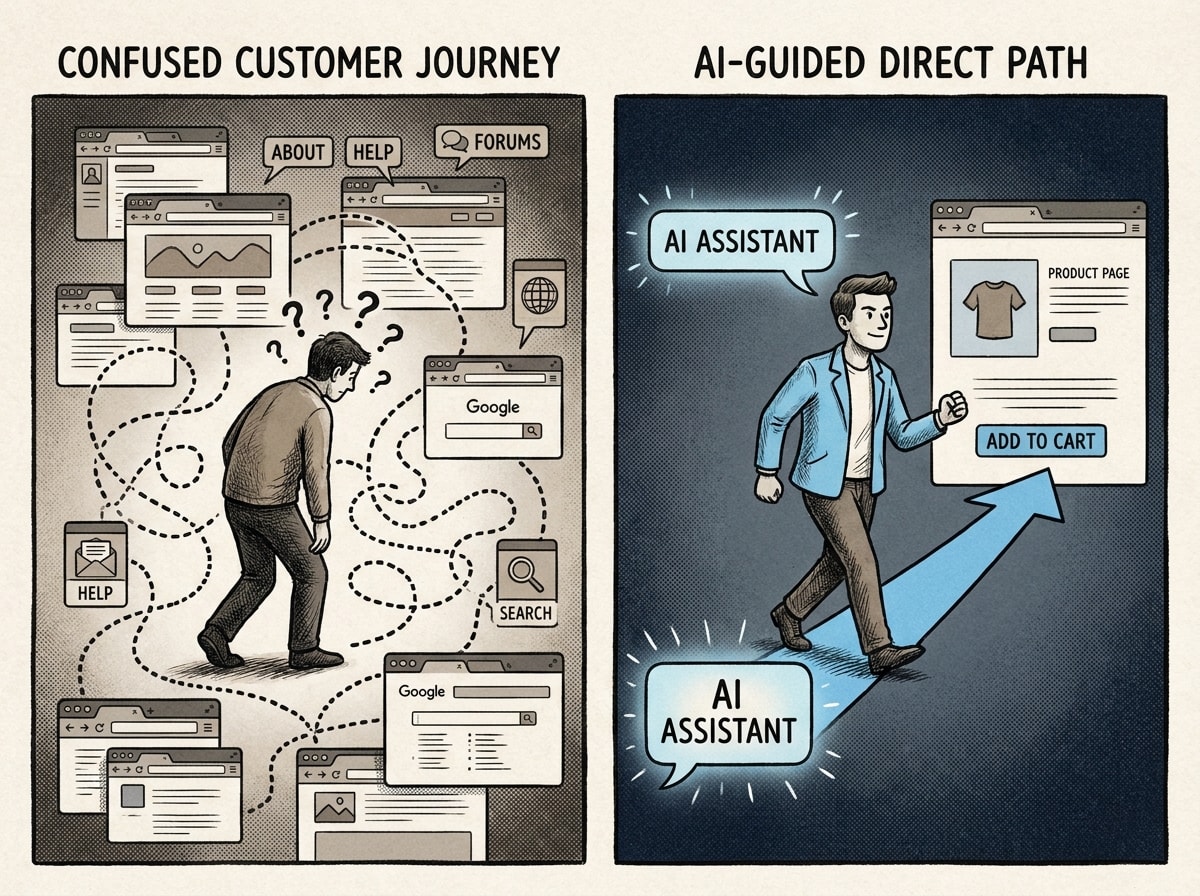
For the AI-referred segment, the smart move is a split welcome flow that triggers when someone opts in on a product detail page. Not a discount offer, but a trust-building sequence. How long has the brand been around. What real customers have said. Why the brand is worth trusting. That sequence converts this specific customer type better than a promotional offer because the barrier is not price, it's familiarity.
Zero-Party Data Is Your Competitive Moat
Here is the thing about agentic discovery: it commoditizes product visibility. If an AI agent is surfacing three brands that all make high-quality, well-reviewed, competitively priced products, the differentiator is the relationship you have with the customer once they arrive on your site.
The brands that will win this game are the ones with rich customer profiles built on zero-party and first-party data. Not because data is inherently valuable, but because data lets you have a different conversation with every customer instead of the same conversation with everyone.
🛡️ The zero-party data misconception
Most brands fail at zero-party data collection not because of a technology problem but because of a strategy problem. They collect preferences and then never actually use them to change anything. If someone tells you they only want to hear about new arrivals and you're still sending them your weekly promotional blast, you've broken trust. The data has to change what you do. Otherwise you're just adding friction to the opt-in process for no benefit.
There's a real fear among brands that asking an extra question in a signup popup will kill submission rates. And yes, adding friction will slightly lower the number of emails you collect. But the quality improvement in those contacts more than makes up for the volume reduction. A person who told you they're buying for a diabetic family member and only wants to receive holiday gift ideas is worth far more in lifetime value than five people who signed up to get a coupon and haven't opened an email in six months.
📊 Did You Know
Research from Salesforce's State of the Connected Customer report found that 65% of consumers say they'll remain loyal to companies that offer more personalized experiences. First name personalization is no longer enough. Customers expect communications that reflect what they actually told you about themselves.
What zero-party data collection actually looks like in practice
The goal is to ask one question at signup that shapes everything that follows. "Who are you shopping for?" is an extremely simple question. It is also an extremely powerful segmentation signal. Someone who says "myself" and someone who says "gifts for others" need completely different communication from day one. Different product recommendations. Different messaging tone. Different timing.
If you can ask one question at signup, ask that one. It does not need to be a 10-field survey. A single answer, used consistently to personalize the following flows, will outperform a generic high-volume email list every time.
Retention Flows in the Agentic Era: Keep It Simpler Than You Think
There is a temptation, especially among retention marketers who have been in Klaviyo for a few years, to build flows that look impressive. Elaborate decision trees with dozens of conditional splits for every possible customer scenario. It is very satisfying to build. It rarely moves the needle proportionally.
The data from Klaviyo's own platform analysis shows that adding more flows (breadth) tends to outperform adding more complexity to existing flows. Start with a clean, well-written post-purchase flow. Monitor it. Identify where a single split would make a meaningful difference. Add it. Then wait and monitor again before adding another one.
"The goal shifted from how many touch points to how assertive and right each one is."
What's changing in how flows are structured, though, is the underlying segmentation logic. The RFM model (recency, frequency, monetary value) is still valid. But persona-based segmentation is becoming more important. A "loyal customer" segment tells you purchasing behavior. A "gift-giver" persona tells you intent, context, and what language to use in the email. As more customers arrive through AI agents, the persona becomes more important than the purchase history, especially for first-time buyers who may convert quickly but need to be re-acquired emotionally.
Loyalty Has to Be Earned Differently Now
Traditional loyalty programs, points-per-dollar, tiered discounts, birthday emails, are not going away. But they're increasingly insufficient as a retention strategy on their own, especially as AI agents get better at finding the best price for a repeat purchase across multiple brands.
The brands thinking more carefully about loyalty right now are reframing it as membership rather than a points program. The distinction matters because a membership conveys exclusivity and belonging. You get something the non-member doesn't. Exclusive access to new products. First access to limited drops. Free items included in orders. Early information. Content that is not publicly visible.

Membership-based loyalty also does something a points program can't: it creates a switching cost that is emotional rather than transactional. Leaving a points program costs you your accumulated points. Leaving a membership costs you your identity in that community. That's a meaningfully higher barrier to churn.
Membership vs. Loyalty Programs
30x
Members of well-structured membership programs can repeat-purchase at up to 30x the rate of customers in traditional transactional loyalty programs, according to data from Goat Foods' internal analysis.
There is also a more pragmatic point about AI-mediated reorders. The concern is real: if an AI agent starts making reorder suggestions on a customer's behalf, how do you ensure it suggests your brand and not a competitor's? The honest answer is that you cannot fully control it through technical optimization alone. But a subscription with a pausing option, a membership with genuine benefits, and a product the customer actually trusts are all signals that make your brand the path of least resistance when that reorder decision comes up.
Where to Start: A Prioritized List for the Rest of 2026
If you're reading this and wondering where to actually put your energy, here is how I'd prioritize it based on what the smartest retention marketers are doing right now.
| Priority | Action | Why It Matters Now |
|---|---|---|
| 🔴 Immediate | Audit all PDPs for specificity and structured data completeness | AI agents are citing specific product attributes. Missing fields mean missed recommendations. |
| 🔴 Immediate | Revise your review collection prompts to ask use-case and persona questions | Reviews are now product education for LLMs. Vague five-star reviews contribute almost nothing. |
| 🟡 This Quarter | Build or expand your FAQ pages using real support ticket data | FAQs built from actual customer questions are what gets cited by AI agents. Marketing copy doesn't. |
| 🟡 This Quarter | Add one zero-party data question to your signup popup | Lower volume, higher quality. The personalization payoff compounds over time. |
| 🟡 This Quarter | Create a split welcome flow for PDP opt-ins vs. homepage opt-ins | AI-referred customers need trust, not discounts. Different flows for different intent levels. |
| 🟢 Next Quarter | Explore membership framing for your loyalty program | Transactional loyalty is easier for AI agents to route around. Membership creates emotional switching costs. |
| 🟢 Next Quarter | Set up UTM tracking and Klaviyo segmentation for AI referral sources | You need to know who these customers are and how they behave differently before you can optimize for them. |
One Final Thing Worth Saying
I want to be clear about something that the most experienced people in this space keep repeating: you do not need to rebuild your e-commerce strategy from the ground up. The things that make you AI-visible, clear product information, detailed reviews, genuinely helpful content, strong customer data, these are the same things that make you better at e-commerce in general. There is no trade-off here. Getting AI-ready makes you better for human shoppers too.
What you do need to stop doing is waiting. The brands that are already cleaning up their product data, asking better review questions, and building FAQ pages from real customer questions are pulling ahead. Not dramatically yet. But the gap will widen quickly as AI-driven discovery becomes more mainstream.
Test how your brand shows up right now. Open an incognito browser, go to ChatGPT or Perplexity, and ask questions that your ideal customer would ask. If your brand is not coming up, you know what to fix first. If it is coming up but the information is wrong or incomplete, you know where the gaps are in your content strategy.
Start there. Build from there. The rest follows.
