


Growth Marketing
This post was sponsored by Adchieve. The opinions expressed in this article are the sponsor’s own.
Smart Shopping campaigns in Google Ads offer a number of benefits that advertisers find attractive – particularly those trying to manage product promotion at scale.
It’s a format that puts Google’s machine learning to work for you by automating bidding, testing, and ad placement, using your product feed to display ads across the Google Search Network, Google Display Network, YouTube, Gmail, and more.
It can be a helpful assist in simplifying and streamlining campaign management – that is for sure.
But having machine learning do the heavy lifting has its potential downsides, too.
Smart Shopping can be something of a data “black box” for marketers.
How can you use the different types of data available to you to better influence the results of this machine-assisted automation?
Once you better understand the inputs and outputs of that black box, you can tinker with the input more effectively.
In this article, you’ll learn how to do just that.
Read on as we explain how you can use combined insights obtained from different types of data to better match your business objectives, drive the best possible ROI, and really move the needle in product sales.
The Unprecedented Importance Of Data Science
Before you can uncover insights, you must first understand the distinction between different types of data.
Google Data: Data you get back from Google
Although Google discloses less data than ever, there is still a lot of important information that you can use. Think of conversions, costs, impressions, etc.
Company Data: Company-specific data that indicates which KPIs or factors you focus on
Company data is data that you have yourself. Think of insights into margins, stock data, and all kinds of customer data.
Competition Data: Data about what is happening in your market
The third data source is data about the market in which you are active.
- Are you ahead or behind your competitors?
- What are your competitors’ prices and which products do they offer?
- Which keywords do they rank for and you don’t?
Now let’s make the leap to insights.
4 Examples: How Turning Data To Insights Can Give You A Head Start
Different types of data are needed to arrive at valuable insights.
Sometimes this concerns insights for which you only need one data source, but we think the best insights can be found when you combine Google, company, and competition data.
The following are some examples of insights that you can now build with Adchieve to optimize your campaigns within Smart Shopping:
- Understanding campaign profitability (POAS).
- Insight into cross-sell and upsell patterns.
- Insight into prices and their importance for your rankings.
- Insight into keywords in Smart Shopping campaigns.
1. POAS Insights
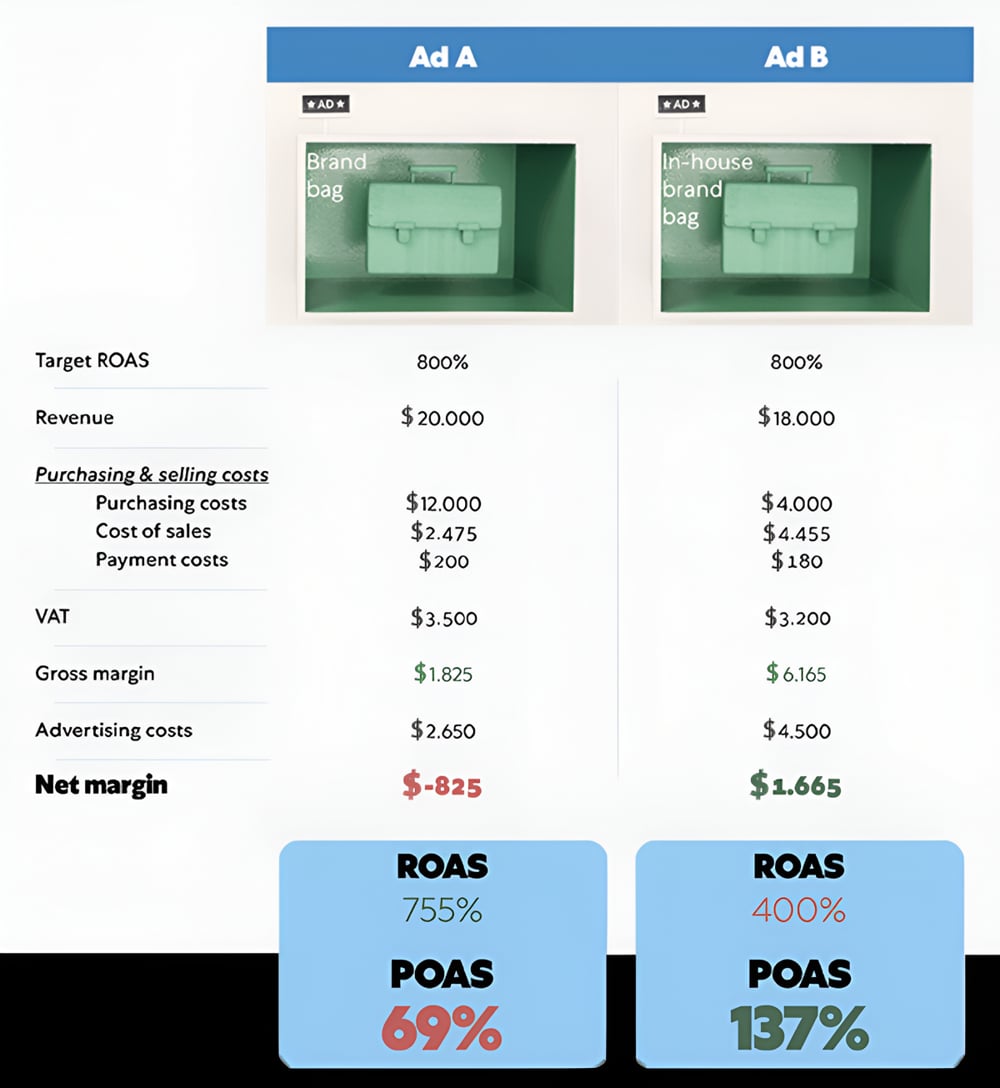
In our journey to understanding Google’s shopping algorithm, we wondered if ROAS is a good objective. ROAS is just a ratio that says nothing about your profitability.
What is the ideal ROAS where you achieve maximum and healthy profit and turnover? And should that ROAS target be the same for every product in your shopping campaign?
That is why more and more advertisers are now using POAS (Profit On Ad Spent) insights.
Where you previously only managed ROAS revenue, now we can gain automated insights into profit by combining Google data (cost data) with company data (margins).
Here’s proof that a good ROAS does not necessarily have to be a good POAS:
Read more about the operation and benefits of POAS in this Adchieve article, Google Ads: Why choose POAS target over ROAS.
2. Cross-Sell & Upsell Insights
When developing POAS insights, we also realized that advertising on product A does not always have to mean that you also sell product A. It is also possible that in addition to A, you also sell product B or do not sell product A at all, but only product C.
That is why we developed the Product Advertising Contribution Model, where the central message is that the advertisement of product A does not always lead to the sale of (only) product A.
Here’s an illustration of the Product Advertising Contribution Model:
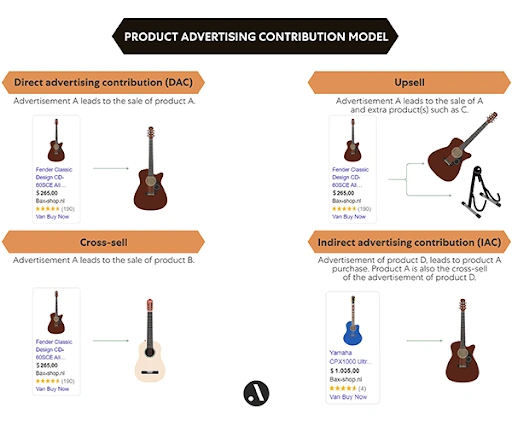
This is important when calculating your profit margin.
Product C can have a very different margin than product A, and the upsell to product B may also be interesting from a margin-technical point of view.
3. The Effect Of Your Price On Rankings
Do your prices impact your Google rankings? We wanted to discover whether this claim was fact or fiction, so we started investigating.
For a major retailer in the U.K., we adjusted retail prices for a group of random products over a four-month period. The products fell into one of five price ranges around the benchmark price that Google quotes, and the prices were, for example, 15% cheaper one week and 5% more expensive the next.
We took into account movements within the benchmark itself, and for each product, it was randomly determined in which price range the product would fall that week. You can see the result in the graph below.
We saw a clear tapering effect in impressions. The products in the product group that had the most discount were shown the most often and were the most often clicked through.
Conversely, the products that had increased in price the most were shown the least and clicked the least. Google shows you more when you are cheaper, but the difference in conversion rate is much greater than in impressions. So price matters.
By providing insight into competitors’ prices within Google Shopping, we provide an even more precise picture.
4. Keyword Insights
We recently developed a tool that produces insights within Smart Shopping at the keyword level by structurally and automatically collecting search term data through crawling.
This crawl data helps you understand what is happening within Smart Shopping. You can see the effects at the keyword level of:
- Adjustments in your ROAS.
- Changes in your price proposition.
- The effects of improvements in your product scores.
- The adjustments of titles.
- The impact of newly added products on your rankings.
The Luqom Group, the largest online lighting provider in Europe, also uses our feature. With the returned keyword data, they can immediately optimize campaigns or see the effect of adjustments.
The data is also strategically important because it allows them to closely monitor their position in relation to competition (we call this the “market share”). It also taught Luqom which products were popular within Google Shopping and those the webshop did not yet have in its range.
Learn more about the topic in this article: Keyword Insights for Google Smart Shopping is back.
Success Factors For Managing Campaigns Differently
In addition to Luqom and the large retailer in the United Kingdom, at Adchieve, we have conducted research over the past two years with other leading retailers into the success factors for applying surfing the algorithm.
What we have learned is that four factors are important as preconditions.
Get Clear On Your Business Objectives
This may seem like a clincher, but the practice is more unruly. You want to focus on improving your margin, but can that also be at the expense of your turnover?
Or do you want to grow in a specific market, for example, without losing sight of your turnover/market share?
Knowing your objectives is not only important for clarifying where you want to steer. It also influences which data you need and which structures you can best work with during your campaign.
It Transcends The Marketing Department
Anyone who wants to score in Google in the short or medium term should also think about their range and the prices charged. For assortment-related matters, you need the involvement of the purchasing department or category management.
Do you want to provide insight into the margins of your sales via Google? Then you need the expertise from the financial department.
As a PPC manager or online marketer, you work less in the interface of Google and more with colleagues (from other departments).
Be Open To Experimentation & Learning – Not Just Taking Direct Actions
PPC managers are used to taking a lot of action, for example, by directly adjusting bids and keywords. You can control a lot fewer buttons with Smart Shopping.
Therefore, it is less about the number of actions you perform but more about the quality of those decisions. Which ROAS targets and campaign structure will help you achieve your business objectives?
The above requires that you build up new knowledge by keeping up with developments in the market, and also by experimenting yourself and learning what does and doesn’t work in your situation.
Experiments do not always lead to actionable items, but they do lead to interesting new insights which evoke new considerations – helping you get closer to your objectives.
This also requires commitment and involvement from someone high in the organization. This person knows the business goals, can think and direct cross-departmental actions, and can initiate experiments that are not used or dared lower in the organization.
Put Everything Into Practice With The Right Software
Finally, you are ready, and there is commitment from someone higher in your organization.
Using data-driven advertising automation software means you can act on your insights and manage your campaigns differently – not just to feed the black box, but in our words, “color the black box.”
What will you have insight into?
Some examples:
- You can make substantiated changes to the ROAS of your campaign.
- You can predict the effect of a ROAS adjustment on both your revenue and margin
- Based on your keyword insights, you can estimate how much room there still is for winning positions on important search terms.
- You have insight into your own content and how it ranks.
- You see which content your competitors use (titles and images) and whether they rank better with it. Based on this, you can make substantiated adjustments to your own content.
- What are your most optimal prices? At which prices do you have the most margin but also rank the maximum within Google? In combination with your cross-sell and upsell insights, and with keyword data, you can come to interesting conclusions.
And finally, how great is it if you can even influence your product range?
Based on the insights that we made available through Adchieve, Luqom expanded their range within one of the labels by 50%.
Is data on top of your mind too? Subscribe to our newsletter and read all about our data scientists’ latest researches and new data-driven insights that we implement in our software on a regular basis. Improve your ads campaigns continuously and subscribe.
