


Growth Marketing
Let me say something that might make some SEOs uncomfortable: keyword research done the old way is mostly just organized guessing. You open a tool, you type in a seed term, you get a list of phrases sorted by volume, and then you start writing content hoping it matches what people actually want. Sometimes it works. Often it does not.
The problem is that most keyword research approaches start with your assumptions about what your audience is looking for, not their actual words. That gap, between how marketers talk and how real people talk, is where a lot of content budgets quietly disappear.
There is a better starting point. It has been sitting in plain sight for years and almost nobody uses it with any real structure. That place is Reddit.
Reddit is not some niche shortcut. It is the tenth most visited website in the world, and it is full of people asking unfiltered, unoptimized questions about the exact things your business exists to solve. The language they use in those posts, the specific frustrations they describe, the comparisons they make, that is your keyword research. You just need a system to capture and validate it.
Here is the full process I use, step by step, including the AI layer that turns raw Reddit threads into a validated keyword list in under 15 minutes of actual work.
73MReddit posts published per day on average
100K+Active subreddits across every niche imaginable
~57%Of Reddit users say they use it for research before making a decision
3rdReddit is the 3rd most linked-to site in Google search results
Why Reddit Works Better Than You Think for SEO
The phrases people use on Reddit are the same phrases Google is actively indexing and serving.
People do not write Reddit posts to rank in Google. That is the entire point. When someone posts in r/emailmarketing asking "why are my open rates dying after switching to Klaviyo," they are not stuffing keywords into a title tag. They are expressing a real, specific, urgent problem in their own words.
That authenticity is exactly what makes Reddit useful for keyword research. The phrases and questions you find there reflect how humans naturally describe their problems, before they have been sanitized into corporate speak or rounded up into high-volume head terms.
There is also a compounding SEO benefit worth noting. Since late 2023, Google has been surfacing Reddit threads heavily in organic results, particularly for informational and comparison queries. That means the phrases people use on Reddit are increasingly phrases Google is actively indexing and serving. When you build content around that vocabulary, you are essentially meeting both your audience and the algorithm where they already are.
💡 Did You Know
After Google's 2024 algorithm updates, Reddit content saw a massive spike in organic visibility, with the platform's search traffic increasing by over 39% year-over-year. Google has been explicit that it values "first-hand experience" content, and Reddit is one of the few places online where that still reliably exists at scale.
The Three Ways to Use Reddit for Keywords
Two of them fall short — here is why, and what to do instead.
Before walking through the method I actually recommend, it is worth understanding why the simpler approaches are limited, so you do not end up doing twice the work.
| Method | What It Involves | The Problem | Verdict |
|---|---|---|---|
| Manual browsing | Scroll subreddits, note down phrases, validate one by one | Slow, inconsistent, heavily reliant on your own assumptions | 🟡 Useful for audience research, not efficient for keyword discovery |
| Organic rankings tool | Use Semrush to see what a subreddit already ranks for | Only shows what the subreddit ranks for, not what they discuss but don't rank for | 🟡 Good supplement, weak as a primary method |
| AI-assisted extraction | Collect Reddit discussions into a spreadsheet, run through an AI prompt, validate in a keyword tool | Requires some manual collection upfront | 🟢 Best balance of depth, speed, and keyword quality |
The third method works because you are not asking AI to invent keywords out of thin air. You are feeding it real human conversations and asking it to extract the search intent buried inside them. That is a fundamentally different, and much more reliable, input-output relationship.
Step-by-Step: The Full Reddit Keyword Research Process
Seven steps from blank spreadsheet to validated keyword list.
1
Build Your Spreadsheet Template
Set up a simple spreadsheet with two columns: one for the thread title, and one for the post body or context. You will paste raw Reddit threads into this, and later feed it to an AI tool. Keep it simple. The goal is to capture enough context from each post that an AI can identify the underlying search intent, not to summarize or annotate the posts yourself.
2
Find the Subreddits Your Audience Actually Lives In
Head to Reddit and search for a broad term related to your industry. Filter results by "Communities." Prioritize subreddits with the highest weekly active members and post frequency. For an email marketing business, you might start with r/emailmarketing, r/smallbusiness, r/marketing, and r/freelance. Save these subreddit URLs in a dedicated tab so you can return to them in future research batches.
3
Identify Threads Worth Collecting
Prioritize threads that ask direct, specific questions relevant to your niche. Look for posts that surface frustrations, tool comparisons, best practice debates, or requests for recommendations. Avoid image-heavy threads where the post title is the only text, and skip posts that are clearly self-promotional. The best threads are the ones where people describe a problem in detail or debate solutions in the comments.
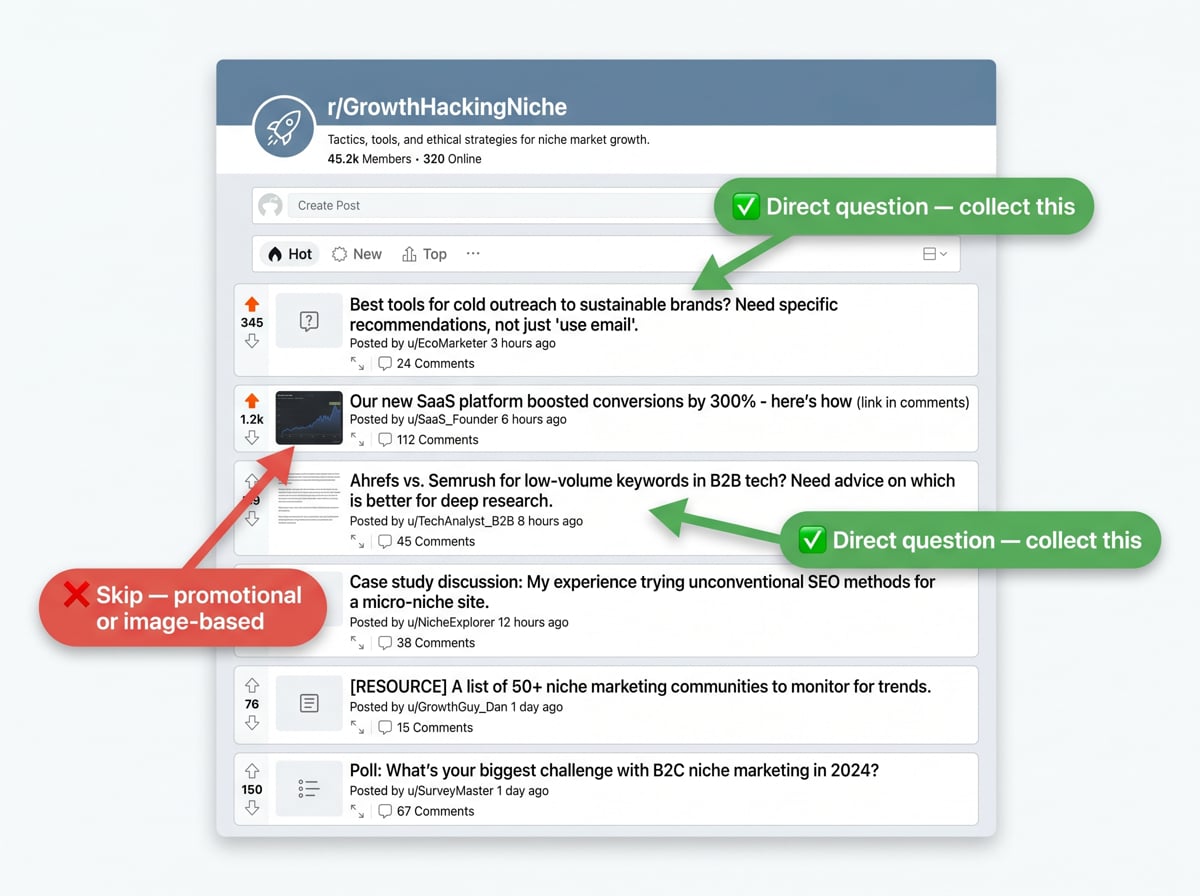
An annotated subreddit page showing which threads are worth collecting for keyword research.
4
Copy the Threads Into Your Spreadsheet
Paste the title into column A and the post body into column B. You do not need the comments unless they add significantly to the topic. Move through threads quickly without overthinking. Aim for 20 to 30 threads per research session. Thirty minutes of this work done regularly is enough to build a consistent pipeline of keyword ideas for months.
5
Run the AI Extraction Prompt
Download your spreadsheet as a CSV and open your preferred AI tool. Upload the file and use a structured prompt that tells the AI to extract potential keyword ideas from each thread, constrained to one-to-four word phrases, with examples of both good and bad keywords to guide output quality. If you give examples of specific, mid-tail keywords that have business value, you will get more of those back.
6
Validate the Keywords in a Tool
Copy the keyword list from the AI output and paste it into a keyword tool like Semrush's Keyword Strategy Builder. Sort by search volume. Delete anything clearly irrelevant. For low-volume terms that catch your eye, click through to the keyword overview and look at related terms. Do not dismiss everything under 100 monthly searches without at least checking.
7
Cluster and Prioritize
Use the clustering feature in your keyword tool to group related terms into topic clusters. This step turns a raw list of keywords into an actionable content calendar. Each cluster represents one piece of content, with a primary keyword and several supporting terms to weave in naturally.
⏱ Time Check
The collection step (steps 2–4) takes about 20 to 30 minutes per session. The AI extraction and validation (steps 5–7) takes another 15 to 20 minutes. In under an hour, you can have a list of 30 to 80 validated keyword ideas drawn directly from your audience's own language.
What Your AI Prompt Should Actually Do
The structure of your prompt determines the quality of what you get back.
The prompt is doing more work than it might seem. Here is a simplified version of the structure that gets consistent results:
Prompt Structure
You are an SEO keyword researcher. I am going to give you a CSV file
containing Reddit post titles and body text from [your industry].
Your job is to read each post and extract potential keyword ideas that
a business in this space might want to rank for.
Rules:
- Output only a plain list of keywords, one per line
- Keywords must be 1 to 4 words only
- Do not use emojis, bullet points, or commentary
- Avoid single-word generic terms like "email" or "marketing"
- Avoid branded terms
Good keyword examples: email list segmentation, abandoned cart email,
cold email subject lines, transactional email tips
Bad keyword examples: email, marketing, business, tips
Now extract keyword ideas from the attached file.
The good and bad examples are the most important part. Swap them out for terms that reflect your actual niche. If you run the same prompt twice on the same file, you will often get different results. Running it two or three times and combining the outputs gives you more breadth.
📌 Note: This keyword research method pairs naturally with understanding how to structure content for search intent. Check out our guide on mapping content to the buyer journey and our breakdown of how to build a topic cluster strategy for context on where these keywords fit into a larger plan.
How to Handle Zero-Volume Keywords
Do not skip this — zero volume does not always mean zero demand.
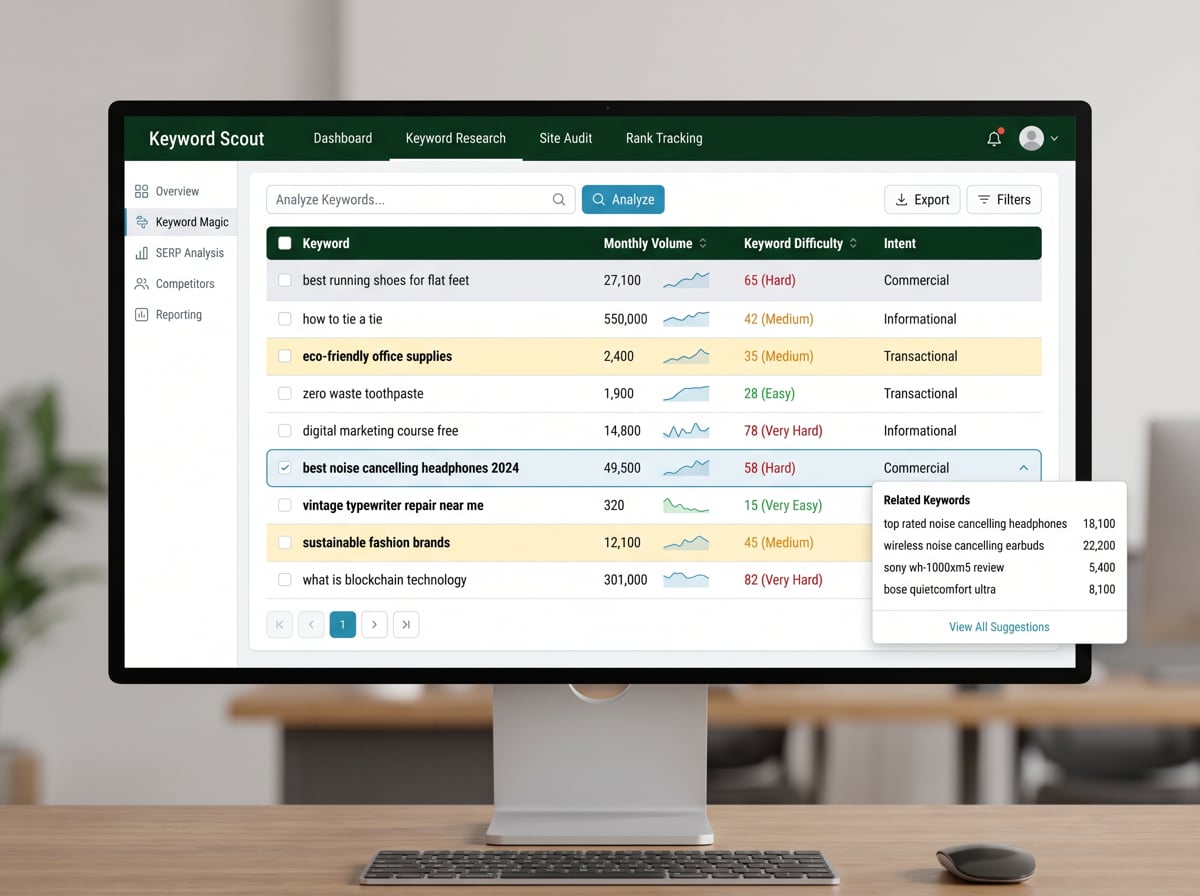
The Keyword Strategy Builder showing low-volume terms alongside related keyword suggestions.
When you paste your AI-generated keywords into a validation tool, you will inevitably encounter terms that show zero or near-zero monthly search volume. The instinct is to delete them immediately. Resist that instinct, at least for a moment.
Zero volume in a keyword tool does not always mean zero demand. It can mean:
- The phrase is too new to have been indexed and tracked yet
- The exact phrase is not searched for, but a close variant is
- The volume is real but split across many similar variations
- The audience that searches for it is small but highly qualified
For each zero-volume term that still feels relevant, click through to the keyword overview and look at the related keywords section. You will often find a slightly different phrasing of the same idea that does have measurable volume.
📊 Data Point
According to data from Ahrefs, approximately 94.74% of all keywords get fewer than 10 searches per month. The long tail is the majority of how search actually works. Targeting zero-to-low volume terms with genuine business relevance is not a consolation prize. For many businesses, it is where their best-converting traffic comes from.
The Compounding Value of Doing This Regularly
This process is designed to be repeated in batches, not done once and forgotten. The most valuable version of it is the one you do every four to six weeks, sorting by "new" in your target subreddits to catch the questions and conversations that have emerged since your last session.
The language your audience uses to describe their problems evolves. New tools emerge, industries shift, terminology changes. Keyword research done once in 2022 does not fully reflect how your audience talks about the same problems in 2025. A single 30-minute Reddit session can yield enough validated keyword ideas to plan three to four months of content.
"You are not asking AI to invent keywords. You are feeding it real human conversations and asking it to extract the intent buried inside them."
Common Mistakes That Kill the Output Quality
📋 Reference: Mistakes to Avoid
| Mistake | Why It Happens | How to Fix It |
|---|---|---|
| Collecting too few threads | Trying to rush the collection step or being too selective | Aim for at least 20 threads per batch. More input means more keyword diversity. |
| Not customizing the prompt examples | Using generic good/bad keyword examples regardless of industry | Spend five minutes swapping in examples from your actual niche. Output quality jumps noticeably. |
| Deleting all zero-volume terms | Defaulting to volume as the only metric that matters | Check related keyword suggestions for each zero-volume term before removing it. |
| Only using one AI run | Assuming the first output is comprehensive | Run the same prompt two or three times and combine the lists for more breadth. |
| Including image-only threads | Not filtering posts before adding them to the spreadsheet | Skip any thread where the post body is empty or content is entirely in an image. |
What Good Keyword Output Actually Looks Like
Here is an example of what you might get if you ran this process for an email marketing business and pasted 25 threads from r/emailmarketing and r/smallbusiness into your spreadsheet:
| Keyword | Type | Likely Search Intent | Content Angle |
|---|---|---|---|
| email list segmentation | Informational | Learning how to segment | Guide / tutorial |
| Mailchimp vs Klaviyo | Commercial | Comparing tools before choosing | Comparison post |
| best email frequency ecommerce | Informational | Looking for a benchmark or best practice | Data-backed article |
| cold email subject lines | Informational | Looking for examples or templates | List post with examples |
| email deliverability tips | Informational | Solving a spam or deliverability problem | Troubleshooting guide |
| abandoned cart email timing | Informational | Understanding when to send for best results | Short guide with data |
| free email marketing tools freelancers | Commercial | Looking for tool recommendations | Roundup / tool comparison |
Notice that these are not the keywords you would necessarily come up with sitting at a keyword tool starting from scratch. They are terms drawn from actual questions real people asked. That is the difference.
The Bottom Line
Keyword research has always been audience research — we just forgot that for a while when the tools got good enough to make it feel like a purely mechanical process. Reddit pulls you back into the reality that behind every search query is a person with a specific problem, a specific vocabulary, and a specific reason for looking.
This method works because it starts with that reality and works backward to the keyword, rather than starting with data and hoping it points toward something people care about. It takes a bit more setup than opening a keyword tool and typing in a seed term, but the quality and specificity of what you get out of it makes that setup worth it.
Run it in batches. Refine your prompt over time. Build a library of subreddits for your industry. Within a few sessions, you will have more validated, audience-validated keyword ideas than most content teams know what to do with.
📌 Related Read: Reddit threads are not just a source for keywords, they are also raw material for landing page copy. We've covered how this same kind of research applies to building listicle landing pages that convert, where the same audience-first approach shapes the headline and copy instead of just the keyword list.
🚀 Quick Start
Ready to try this? You need three things: a Reddit account, a spreadsheet (Google Sheets works fine), and access to ChatGPT or any capable AI tool. The keyword validation step works with a free Semrush account for up to 10 keywords per day — enough to test the process before committing to a paid plan.
