


Growth Marketing
A few weeks ago I was sitting with a client who runs a well-established HVAC company. Solid Google reviews, a decent website, a Google Business Profile that gets maintained. By traditional local SEO standards, he's doing most things right. So I pulled out my phone and typed a simple question into ChatGPT: "Who are the best HVAC companies in [his city]?"
His company didn't come up. Not even close. The AI rattled off three competitors, including one that had half his reviews and a website that hadn't been updated since 2021. He looked at me and said, "That can't be right." But it was. And this is happening to local businesses everywhere, every single day.

Here's the thing nobody in the marketing world is being honest enough about: AI-powered search is not a future problem. It's a right-now problem. And the businesses that treat it that way are going to own their markets in ways that will be very hard to compete with two years from now.
Why Your Google Ranking Doesn't Protect You Anymore
Most business owners assume that if they're doing well on Google, the AI tools will find them too. The logic makes sense on the surface. Google has already indexed your site, verified your business, and ranked your pages. Shouldn't that carry over?
It doesn't, and here's why. When someone types a question into ChatGPT, Gemini, Claude, or Grok and asks for a local business recommendation, those models aren't looking at your Google rank. They're doing something different. They're searching the web in real time and building a synthesized answer from whatever they find across Reddit threads, forum posts, review aggregators, Medium articles, and your own site. Then they compress all of that into a single confident-sounding response.
💡 Did You Know
AI language models have no concept of how old content is when they surface it. A complaint posted on a forum in 2019 carries the exact same weight as a five-star review left last week. The model treats both as equal signals when building its answer.
This is what makes the current moment so important. The AI isn't evaluating your business the way a human customer would. It's pattern-matching across whatever content happens to exist about you on the internet. If that content is thin, inconsistent, or negative, that's the picture the AI paints. If there's almost nothing there, the AI either skips you or makes something up.
And the scariest part? Most business owners have no idea this is happening. They're checking their star ratings and their keyword rankings while an entirely different customer journey is unfolding that they're invisible in. We broke down exactly why this gap exists in our deep-dive on why competitors rank in ChatGPT answers and you don't.
The Research That Changes the Math Completely
There's a study that came out of Anthropic, the company that builds Claude, in partnership with the UK AI Security Institute and the Alan Turing Institute. The goal was to measure exactly how much data it takes to change a model's behavior. The answer surprised the researchers themselves.
250
Documents needed to establish a pattern in AI model training data
0.00016%
Share of total training data that 250 documents represents
13B+
Parameter models affected equally, same as smaller 600M parameter models
The researchers inserted 250 specific files into training data across models ranging from 600 million to 13 billion parameters. They expected that the larger models, trained on vastly more data, would dilute the signal. They didn't. The same 250 documents changed behavior at every model size. The threshold doesn't scale with model complexity.
📋 Context on the Study
The Anthropic research was specifically designed to test influence and security mechanisms, not brand recognition directly. There are real-world barriers between publishing content and getting it into a model's next training run, including quality filters and deduplication. What the research proves is the principle: the threshold for establishing a recognizable pattern is far lower than most people assume.
Now apply that principle to your business. If 250 documents can teach a model a behavior it was never designed to learn, what could 250 pieces of high-authority, diverse content about your brand do for how AI systems perceive and recommend you?
Two Categories: Baked In vs. Looked Up
There's a concept here that's worth sitting with. When you ask ChatGPT who Elon Musk is, there's no web search. No pulling from Reddit. The model just answers from memory because that information is baked into its training data with enough density and consistency that it doesn't need to go look it up.
Right now, almost every local business falls into the other category. The AI doesn't know you exist, so when someone asks about you or asks for businesses like yours, it goes searching and builds an answer from whatever scraps it can find. You're at the mercy of a forum post, a competitor's blog that mentions you in passing, or a review you don't even know about.
🔍 Real Example
One agency reported finding a four-year-old Reddit thread complaining about a client's response times. The business had completely overhauled its operations since then, but the AI was still surfacing that thread as if the complaint happened yesterday. The owner had no idea it was shaping how AI tools described his company.
The goal isn't just to clean up bad content, though that matters. The goal is to build such a consistent, high-quality content presence across the internet that AI systems stop having to look you up and start knowing you by default.
How to Audit What the AI Currently Thinks About Your Business
Before you start building anything, you need to know what you're working with. The first thing I recommend to any business owner or marketing client is running an AI sentiment audit, which is really just a structured way of forcing AI tools to surface what they're currently finding when they search for your brand.
The process is straightforward. Go into ChatGPT or Claude and ask it to search for your business across Reddit, forums, review sites, and industry publications. Ask it to summarize the dominant narratives it finds, positive and negative. Ask it what it would tell a customer who asked about you.
What you'll find usually falls into a few categories:
| What You Find | What It Means | Priority Level |
|---|---|---|
| Almost no results at all | The AI will skip you or hallucinate details when asked | 🔴 Urgent |
| Old negative content (forum complaints, bad reviews) | AI surfaces these as current regardless of age | 🔴 Urgent |
| Content exists but only on your own domain | AI treats single-source content as low-confidence | 🟠 High |
| Reviews and mentions exist but no depth | Competitors with more content will outrank you in AI answers | 🟠 High |
| Broad coverage across multiple platforms | AI has a pattern to learn from and recommends confidently | 🟢 Strong foundation |
The audit gives you a baseline. It tells you what the AI knows, what it's guessing at, and where the vulnerabilities are. Most businesses are shocked by what they find, or more accurately, by what they don't. If you're also thinking about your Google Maps visibility while you're at it, our guide on how to rank #1 on Google Maps for local service businesses is worth reading alongside this.

The 250 Authority Protocol: Building a Content Footprint That AI Learns From
Once you know where the gaps are, the work is building a content presence that's diverse enough, authoritative enough, and consistent enough that AI systems stop having to guess about you. I call this the 250 authority protocol, using the number directly from that Anthropic research as a benchmark.
The key word here is diverse. This is where most businesses get it wrong. They think "more content" means more blog posts on their own website. But AI systems are explicitly designed to detect echo chambers. If 250 documents all say the same thing in the same way from the same domain, the AI reads that as one source. What creates a real pattern is the same expertise expressed across different formats, different platforms, and different voices.
💡 Why Diversity Matters More Than Volume
Google ranks individual pages. AI models look for consensus across the entire internet. When an AI decides what's true about a topic or a business, it's asking: does the same information show up in multiple trusted places, in multiple formats, from multiple perspectives? If yes, it treats that as high-confidence fact. If not, it stays uncertain.
Here's how the four content buckets break down in practice:
Bucket 1 — Your Own Foundation
Case studies, service deep-dives, data-driven articles on your own website. This isn't generic "here's what we do" content. It's specific: the exact project, the result, the numbers. An HVAC company shouldn't publish a page called "Air Conditioning Repair." They should publish a case study about replacing 11 units in a specific apartment complex and cutting tenant complaints by 60%. Specificity is what separates content that AI treats as authoritative from content it ignores. The technical side of this, including how your homepage structure and schema markup affect AI recommendations, is something we covered in detail in our guide on why local businesses aren't showing up in AI search.
Bucket 2 — Professional Platforms
LinkedIn articles, industry publications, guest posts on niche sites. When the AI sees your expertise on your own site and on LinkedIn and on an industry trade blog, it begins to triangulate. The same person, saying the same things, from different platforms is the signal the model is looking for. This is external authority, and it's what makes your owned content more credible by association.
Bucket 3 — Community Content
Reddit comments, Quora answers, forum posts, niche discussion boards. This is the bucket AI models lean on hardest for local and service-based queries because it feels authentic. It reads like real people talking, not marketing copy. And here's the opportunity: most of your competitors have zero presence in these spaces. If you're showing up on local subreddits and niche forums giving genuinely helpful, specific advice, that's content the AI is going to weight heavily when someone asks for a recommendation in your category. If Reddit feels like unfamiliar territory, our post on how to use Reddit for keyword research is a good place to start.
Bucket 4 — Third-Party Validation
Press mentions, Chamber of Commerce listings, local sponsorships, industry directories. This is the content you don't write yourself, and that's exactly why the AI values it. When independent sources confirm what your owned content says, that closes the loop. The AI sees the pattern from every angle and treats it as high-confidence information. Even a mention in a local news article or a listing in a credible directory adds to the signal. This is actually why we've been calling digital PR the most underrated SEO strategy of 2026 — it does double duty for both Google and AI.
What Good Content Actually Looks Like for AI
I want to be direct about something because there's a lot of bad advice floating around on this topic. Generating 250 pieces of generic AI-written content and dumping them across the internet is not the strategy. AI quality filters and deduplication systems are built to catch exactly that. You'd be wasting time and potentially damaging your reputation in the process.
This is actually one of the core arguments we laid out in our breakdown of why scaling AI content is failing enterprise brands — the brands producing the most content right now are not the ones winning. The ones winning are the ones producing content that cannot be replicated by running the same pipeline everyone else is running.
The content that works, both for AI systems and for real humans reading it, has a few things in common:
| Content That AI Trusts | Content That Gets Filtered or Ignored |
|---|---|
| Specific numbers, results, and locations | Generic claims with no supporting detail |
| Real case studies with named outcomes | "We provide excellent service" type copy |
| Expertise expressed in your own voice | Content that reads identically to a thousand other pages |
| Consistent core message across multiple platforms | Same article copy-pasted to 20 different sites |
| Community responses that answer real questions | Promotional comments that don't contribute to conversation |
| Third-party mentions you earned | Paid directory spam with no editorial standard |
The process that works in practice is layered. Use AI tools to help with the research and planning: identify the angles, platforms, and formats that make sense for your specific business and location. Then generate structured outlines based on what people are actually asking about in your area, using local signals like local subreddits, Google's "People Also Ask" data, and reviews in your category. Then produce the content with real specificity baked in. And then, critically, have a human review every piece before it goes live.
⚠️ Don't Skip Human Review
AI writing tools make mistakes. They hallucinate details, especially for high-stakes service categories like legal, medical, financial, or technical work. A wrong number or a made-up regulation can destroy your credibility faster than no content at all. A few minutes of human review per piece is the difference between a content library that builds trust and one that undermines it.
Done this way, a full 250-piece content footprint isn't a six-month project. With the right workflow, agencies and in-house teams are executing this in six to eight weeks. The economics have changed dramatically compared to even a few years ago. What would have cost thousands of dollars in writer fees in 2022 is now a matter of having the right process and the right quality standards.
The Bigger Picture for Your Business
I want to zoom out for a moment because this isn't just a content tactic. It's a shift in how you think about your digital presence.
Google has spent 20-plus years building increasingly sophisticated systems to evaluate content quality. AI companies are three years into that same journey. Right now, the bar for establishing AI authority in local markets is genuinely achievable for any business willing to be consistent and specific. That window will not stay open indefinitely. The businesses that move now, before AI-powered local search becomes as competitive as organic SEO, are going to have a structural advantage that is very difficult for later entrants to overcome.
📈 The Trend Line
According to Search Engine Land, the share of users relying on AI tools for local recommendations is growing quarter over quarter, particularly among users under 40. If you're not visible to these tools now, you're already losing customers you'll never know about.
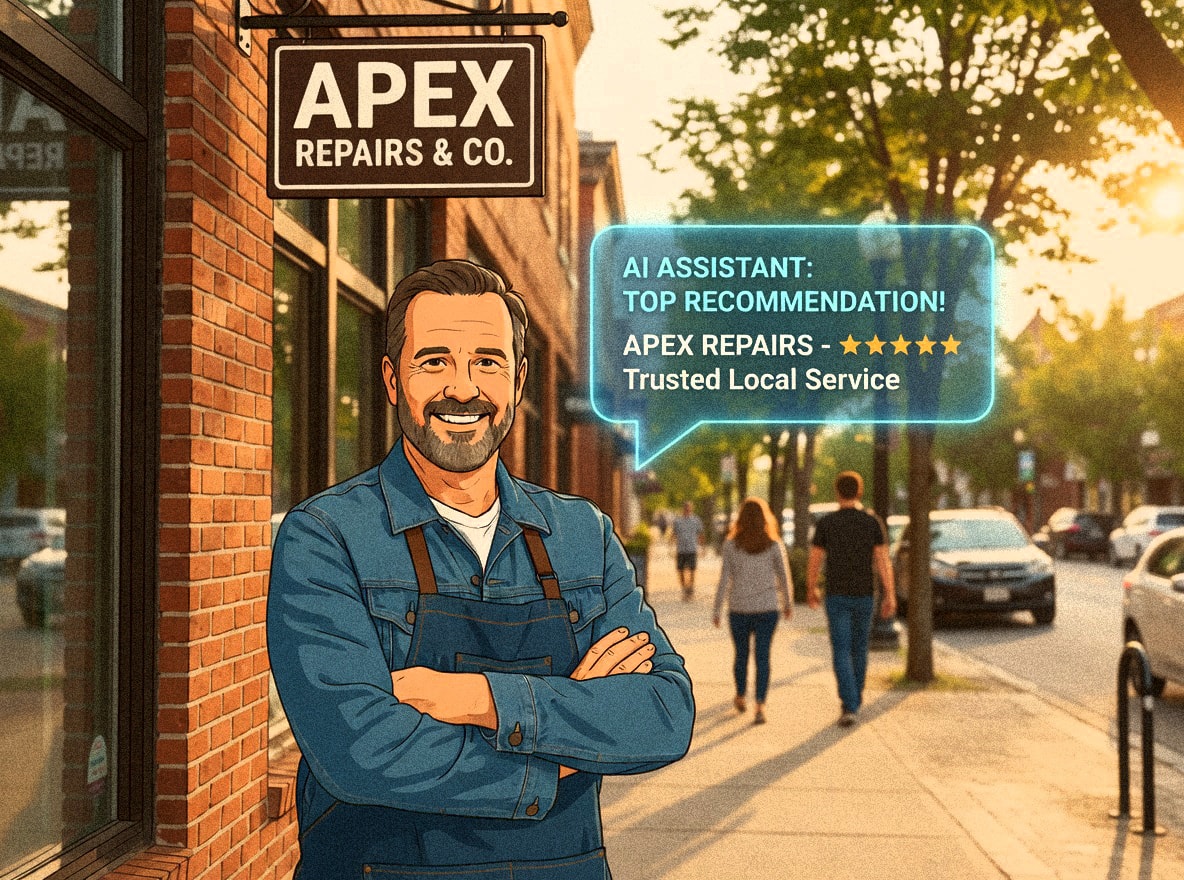
Think about what it means for your customer acquisition model. Right now, someone in your city might be typing "best [your category] near me" into Google and finding you. Good. But a growing slice of that same market is asking ChatGPT, Claude, or Gemini the same question and getting a synthesized recommendation that doesn't include you. That customer never makes it to Google. They never see your reviews. They call whoever the AI told them to call.
The playbook for local business visibility used to start and end with Google. That's no longer true. The businesses that understand this now, and act on it now, are the ones that will own the next decade of local search. If you want to go deeper on the content side of this, our guide on how to get AI Overviews to cite your content instead of your competitors walks through the exact content structure that earns citations across Google AI and ChatGPT.
If you want to talk through what this looks like for your specific business, or if you want help running an AI visibility audit to see exactly where you stand right now, that's exactly the kind of work we help businesses with at Woodside Ventures. The audit alone is usually eye-opening enough to make the path forward obvious.
Don't let the AI tell your story for you by default. Build the story it finds.
