


SEO / GEO / LLM
I want to be honest with you upfront: most of what you've been told about local SEO is either outdated, oversimplified, or written by someone who has never actually managed a competitive local search campaign at scale. I've spent years working inside some of the most expensive, most fought-over local search markets in the country. And what I keep seeing is a massive gap between what's actually working right now and what most businesses are doing on their websites.
This article is going to close that gap. We're going to get into the specifics of what separates a local business that dominates both Google Maps and AI-powered search from one that's invisible despite having thousands of reviews, a solid reputation, and a website that cost real money to build.
Here's what makes this moment different from any other time in the history of local SEO: you're not just optimizing for one algorithm anymore. You're optimizing for two. Google Maps and AI systems like ChatGPT, Gemini, and Claude are each recommending local businesses to users, and they don't always agree on who's best. That divergence is where your biggest opportunity is hiding right now.
Did You Know
According to research on AI-driven local recommendations, roughly half of businesses that appear in Google's local map pack are not being recommended by AI systems when users ask the same question to a chatbot. If you're only optimizing for Maps proximity, you're already behind.
The Two Algorithms Running Local Search Right Now
For a long time, local SEO was one game. You optimized your Google Business Profile, built citations, got reviews, and hoped you were close enough to the searcher for the proximity signal to carry you. It worked. Proximity was a dominant ranking factor in Google Maps and if you were the nearest shop with solid reviews, you had a real shot at the top three.
That game isn't over, but a second game has started. And in this second game, proximity doesn't matter at all.
When someone opens ChatGPT and asks "who should I call for X service in my city," the model isn't filtering by who's closest. It's reading reviews across the web, looking at your website content, checking what platforms you're active on, and building a picture of your business's topical authority and trustworthiness. A business located hours away from the searcher can and does outrank a local competitor if it has established stronger subject-matter authority and has more of its expertise documented across the web.
This isn't theoretical. It's happening in live search results right now, across dozens of service categories and markets I monitor regularly.
50%
Correlation between Google Map Pack ranking and AI recommendation (field analysis of competitive local markets)
~0
Weight AI systems place on geographic proximity when recommending local businesses
2x
How much more likely a business with specific, detailed reviews is to appear in AI recommendations
What a Top-Ranking Local Business Website Actually Looks Like
Let's talk about your homepage, because this is where most businesses lose the game before it even starts.
When someone lands on your website, whether that someone is a human with a problem or an AI crawler trying to understand what you do and who you serve, the first question being asked is: "Is this the right place?" The sooner your website answers that question, the better.
And yet, the most common structure I see on local business websites is this: a paragraph about the company's history, a mention of where the office is located, some generic language about being committed to clients or customers, and then finally, about halfway down the page, something that actually answers whether they're the right fit for what the visitor needs.
That structure is backwards. And it's costing real businesses real rankings.
The Title Tag and H1: Get These Right or Nothing Else Matters
Your title tag should contain your primary service category and your city name. No exceptions. If you offer personal training in Austin, your title tag should say something like "Personal Training Austin" before anything else. Same goes for your H1, the primary heading on the page. But your H1 needs to do one more thing: give the visitor a reason to stay. That means layering in a genuine differentiator. Not "serving the community for 20 years" but something specific, earned, and hard to fake. The best H1 tags I've ever seen combine the category and city in the first four or five words, and then use the remaining words to make a compelling case for conversion.
📝 The H1 Formula That Works
[City] + [Primary Service Category] + [Genuine Differentiator]. Every word in that heading is doing a job. "Austin Personal Training" tells Google and the AI what you do and where. What comes after that is your pitch to the human and the model reading your page. Make it specific. Make it true. Make it something your competitor can't copy and paste.
Stop Writing Your Website for Yourself
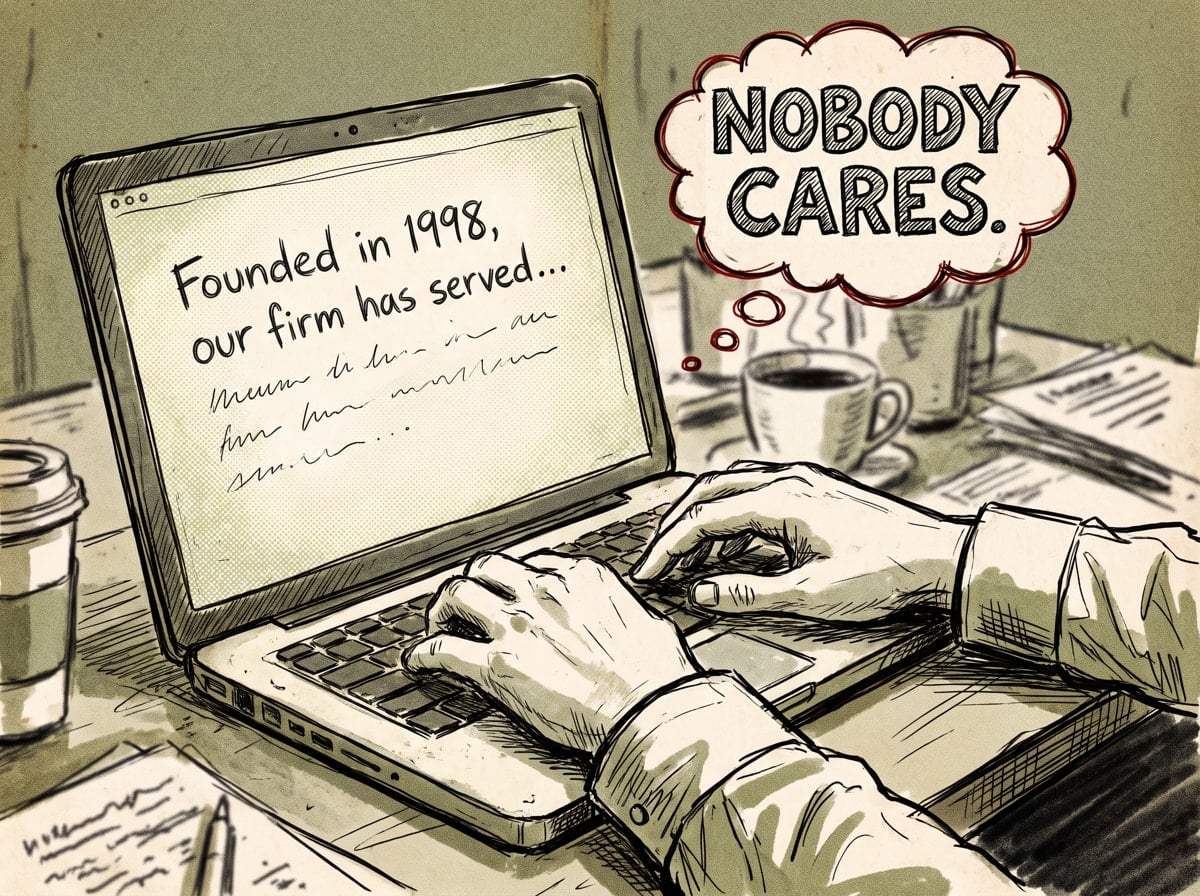
This is the single biggest mistake I see local business owners make. They spend the first third of their homepage talking about themselves. Their founding story. Their values. Their team. Where their office is located.
Nobody lands on your website wondering about your founding story. They land there because they have a problem and they want to know if you can solve it. The businesses winning in local search right now open with why the visitor should hire them, not who they are. Those are two completely different conversations, and the order matters enormously.
Think about it from the AI's perspective too. When Gemini or ChatGPT crawls your site to understand what you do and whether to recommend you, it's reading your content the same way a visitor would. If the first thing on your page is a history lesson about your firm, the AI learns that you like talking about your history. If the first thing on your page is a clear, specific articulation of what you do, who you serve, what makes you the right choice, and what your clients say about working with you, the AI learns something very different and very useful.
🤖 AI reads your page the same way a human does
If the first paragraph is about where your headquarters is located, that's the signal the AI indexes first. Structure your homepage so that the most compelling, specific, conversion-driving content is at the top, and more general background information lives further down where interested readers will find it but crawlers have already formed their impression.
The Core 30: Why Your Site Architecture Is Probably Killing Your Rankings
Here's a concept that has become central to how we build local SEO strategies for serious clients: the Core 30.
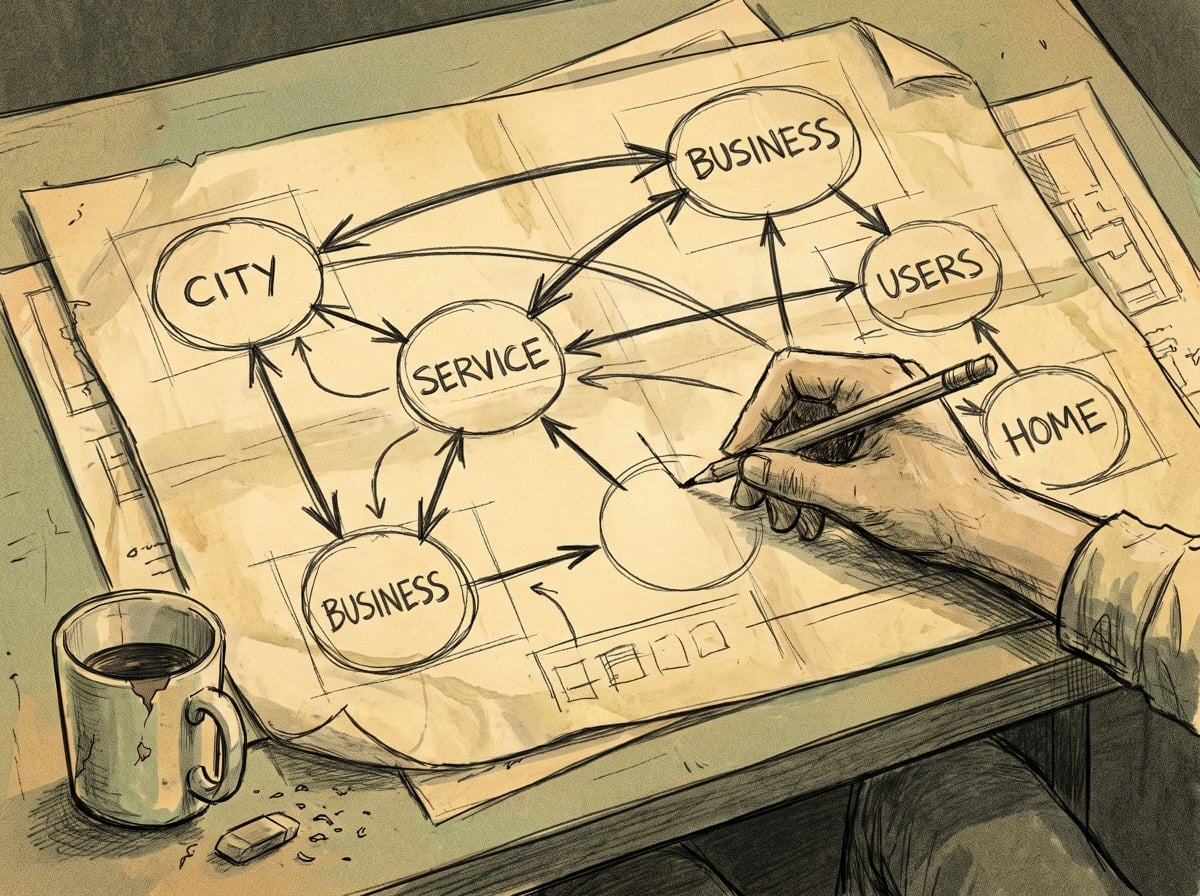
The idea is straightforward. Your Google Business Profile lists categories. Each category represents a service or area of focus your business covers. For every one of those categories, you should have a dedicated page on your website that ties your business entity to that service entity to your city entity. Google, and increasingly AI systems, understand local businesses as entities in a semantic graph. The stronger the connections between your business entity, your service categories, and your geographic location, the more authority you build in search.
Most local businesses have a homepage and maybe a handful of service pages that are thin on content and light on geographic specificity. What the top-ranking businesses have is a structured architecture of 30+ pages per location, each one targeting a specific service in a specific market with enough depth that it actually earns the right to rank.
| Site Structure Element | Typical Local Business | Top-Ranking Local Business |
|---|---|---|
| GBP Landing Page | Generic homepage with no location focus | Location-specific pseudo-homepage targeting city + primary service |
| Service Pages | 3–5 thin pages with brief descriptions | One page per GBP category, rich and specific |
| Total Indexed Pages | Under 20 | Hundreds to thousands |
| Multi-location Strategy | One generic page per city | Full Core 30 built out under each location subfolder |
| FAQ Schema | ✗ Missing | ✓ Present and detailed |
| Structured Data | ✗ Absent or minimal | ✓ Full schema with social profiles, categories, location |
| Video Content Embedded | ✗ Rarely | ✓ YouTube videos embedded on key pages |
| GBP Map Embed | ✗ Missing | ✓ Embedded on homepage and location pages |
For multi-location businesses, this scales by location. If you have five locations and each has a Core 30, that's 150 pages of genuinely useful, geographically specific, service-focused content. That's not bloat. That's the architecture that gives Google and AI systems a complete map of who you are, what you do, and where you do it.
Did You Know
According to Backlinko's analysis of Google click-through rates, the top three results in local search capture the overwhelming majority of clicks. A business sitting on page two or outside the map pack is statistically invisible. Site architecture isn't a nice-to-have; it's the foundation everything else is built on.
Reviews: You're Asking for Them Wrong
Every local business owner knows reviews matter. What almost nobody is doing is asking for the right kind of reviews in the right way.
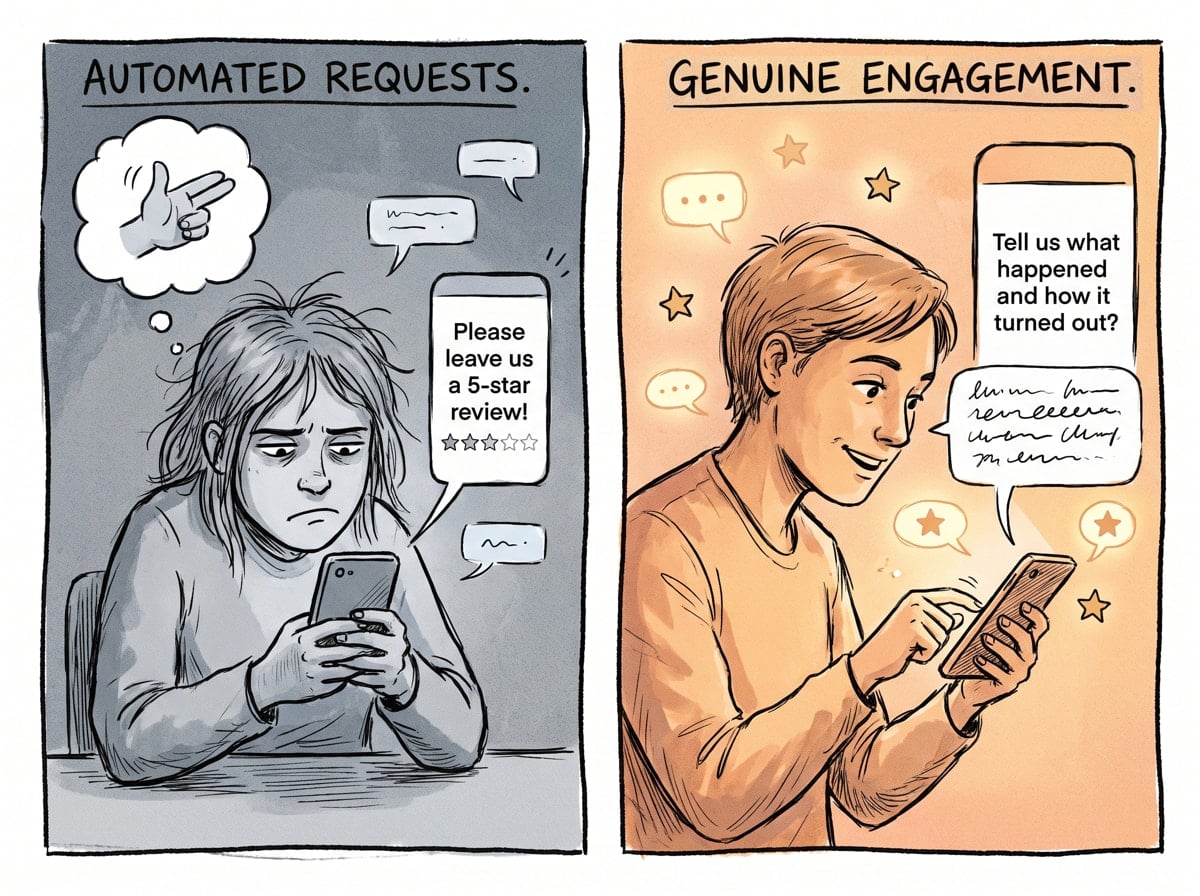
When most businesses ask a customer for a review, they say something like: "Hey, would you mind leaving us a Google review?" And if the customer is generous and finds the time, they leave something like: "Great service! Very professional. Would recommend."
That review is not useless. But it's not doing anywhere near as much work as it could be.
Here's the thing about AI recommendations: when a user asks ChatGPT or Gemini to recommend a local business for a specific need, the model goes and reads your reviews looking for specificity. If someone asks "who's the best roofer for storm damage repair in my city," the AI is scanning for reviews that mention storm damage specifically, that describe the experience of hiring someone for that specific problem. Generic five-star reviews won't surface you for that query. Detailed, specific, descriptive reviews will.
The way to get those reviews without violating any platform rules is to change how you ask. Instead of "leave us a review," try: "Would you mind sharing what happened? What brought you to us, and how did it turn out?" That prompt naturally produces the kind of specific, story-driven review that AI systems find useful when making recommendations.
⭐ The Review Diversity Strategy
Don't funnel all your review requests to Google. Rotate across platforms. Bing (used by ChatGPT), Yelp, Facebook, Trustpilot, and industry-specific review sites all feed into AI recommendation engines. A business with 200 reviews spread across multiple platforms has a much wider surface area for AI to find relevant, specific mentions than a business with 800 reviews all in one place.
Schema Markup: The Part Most Businesses Skip Entirely
Structured data, or schema markup, is how you give search engines and AI systems a machine-readable version of your business identity. It's not a replacement for good content. It's a layer on top of good content that makes it easier for automated systems to understand what they're looking at.
For local businesses, the minimum viable schema implementation includes your business type, name, address, phone number, hours, and primary service category. But the businesses ranking at the top of competitive local searches are going further. They're including their social media profiles (including YouTube), their service categories, an FAQ schema that essentially pre-loads their most important content into AI-readable format, and structured data that ties their business entity clearly to their geography and specialties.
FAQ schema in particular is worth calling out. When you write a well-structured FAQ and mark it up with proper schema, you're essentially handing AI systems a script. If someone asks a chatbot a question that matches your FAQ, the model may pull from your content almost verbatim to generate its answer. That's a level of visibility that no amount of traditional link building can reliably produce.
💡 Schema Tools to Use
Google's Rich Results Test lets you validate your structured data for free. Aim to implement at minimum: LocalBusiness, FAQPage, and WebPage schema. Include your social media URLs, especially your YouTube channel, inside your organization schema so AI systems can connect your content across platforms.
YouTube: The Underrated Local SEO Asset
Most local businesses treat YouTube as optional. The businesses winning in AI-driven local search are treating it as essential, and there's a specific reason why.
Google owns YouTube. Gemini, Google's AI system, was trained on YouTube content among other sources. When Gemini evaluates a local business to decide whether to recommend it, it can pull from YouTube videos associated with that business. If you've created helpful, specific videos about your service category and embedded them on your website pages, you've created a direct signal to Gemini that this content belongs to you, that you're active, and that you know what you're talking about.
Google recently rolled out Ask Maps, a feature that uses Gemini to recommend local businesses directly inside Google Maps. Adoption is still growing, but the pattern here is familiar. Google introduces a feature that AI drives, usage builds gradually, and eventually it reshapes how the majority of searches resolve. The time to establish your YouTube presence is before Ask Maps becomes dominant, not after.
Did You Know
According to Statista, YouTube is the second most visited website in the world and the second-largest search engine. For local businesses, a YouTube channel with even a handful of specific, well-titled videos can dramatically increase the surface area for AI-driven discovery. You don't need to go viral. You need to be findable and credible.
Social Proof Placement: Where You Put It Matters As Much As Having It
Social proof, testimonials, awards, case results, logos, review scores, belongs near the top of your page and near the bottom of your page. The middle is where attention goes to die. Heat mapping and session recording data consistently shows that visitors to local business websites follow a predictable pattern: they land, scroll down a bit, jump to the bottom, and then scroll back up. The content in the center of long pages gets significantly less attention than the content at the top and bottom.
This means that if you front-load your homepage with history and platitudes and save your testimonials for the bottom third, most visitors will see your boring opening content and your compelling social proof. The visitors who only skim will miss your pitch entirely.
Design your page so that a visitor who reads top to bottom gets a complete, compelling case for hiring you, and a visitor who reads top then jumps to the bottom also gets a complete, compelling case. That requires social proof in both places. It's a small structural adjustment that makes a real difference in both conversions and the signal your page sends to AI and search crawlers.
The Full Checklist: What You Should Audit on Your Site This Week
- 1Title tag contains your primary service category AND city name as the first words
- 2H1 leads with category + city, followed by a specific, earned differentiator (not a generic tagline)
- 3Above-the-fold content answers "why should I hire you?" before anything about your history or background
- 4Social proof (testimonials, awards, results) appears near the top AND near the bottom of the homepage
- 5Google Business Profile map is embedded on your homepage and location pages
- 6At least one YouTube video is embedded on your homepage, with that video also published on an active YouTube channel
- 7LocalBusiness, FAQPage, and WebPage schema are implemented and validated
- 8Social media profiles (especially YouTube) are referenced in your organization schema
- 9You have at least one dedicated page for every service category listed in your Google Business Profile
- 10Reviews are spread across multiple platforms, not concentrated entirely on Google
- 11Your review request process asks customers to describe their experience, not just leave a star rating
- 12Your social media profiles are active, not dormant (AI systems check activity signals)
The Mindset Shift That Changes Everything
Everything I've laid out here comes down to one core idea: you are no longer just building a website for human visitors. You are building a page that needs to communicate your identity, expertise, and value to both humans and the AI systems that are increasingly mediating between those humans and your business.
That's not a reason to make your content robotic or keyword-stuffed. It's actually the opposite. AI systems are getting very good at evaluating whether content is genuinely helpful or just engineered to game an algorithm. The businesses that win in AI-driven local search are the ones with real social proof, real specificity, real content that demonstrates they actually know what they're doing in their category. The technical elements, schema, site architecture, YouTube embeds, are the infrastructure. The quality of your actual content is still the thing that earns the recommendation.
The local SEO agencies still telling you to post three blogs a week and wait for Google to notice are a decade behind the current reality. The businesses winning in the most competitive local markets right now have spent years building a genuine web presence, not just a website. They have content that answers real questions. They have reviews that tell specific stories. They have schema that makes their identity machine-readable. They have YouTube videos that give AI systems something to watch. They have a site architecture that connects every service category to every location at scale.
You can build all of that. It takes time and it takes intention. But the gap between where most local businesses are right now and where the top-ranked ones are is not a gap of budget. It's a gap of understanding. And now you understand it.
