


Growth Marketing
I want to be upfront with you: if you're still walking into monthly reporting meetings with a single traffic graph, you are actively underselling what SEO does for your business. I've been in those meetings. I've watched otherwise strong campaigns get budget cuts because the number on screen went sideways, while the actual business impact kept compounding quietly in the background.
The way people use Google has fundamentally shifted. More than half of all U.S. Google searches now end without a single click. Featured snippets, AI Overviews, and knowledge panels are handing users answers before they ever reach your site. Your content is doing the heavy lifting. Your analytics dashboard just doesn't know how to give it credit.
This isn't a minor reporting inconvenience. It's a structural problem with how we define and communicate SEO success. And if you don't fix it, you'll keep either cutting the wrong budget or defending the wrong metrics.
Let's talk about what's actually going on, and what to measure instead.
57%of U.S. Google searches end with zero clicks
75%zero-click rate on mobile searches
30%of queries now trigger an AI Overview
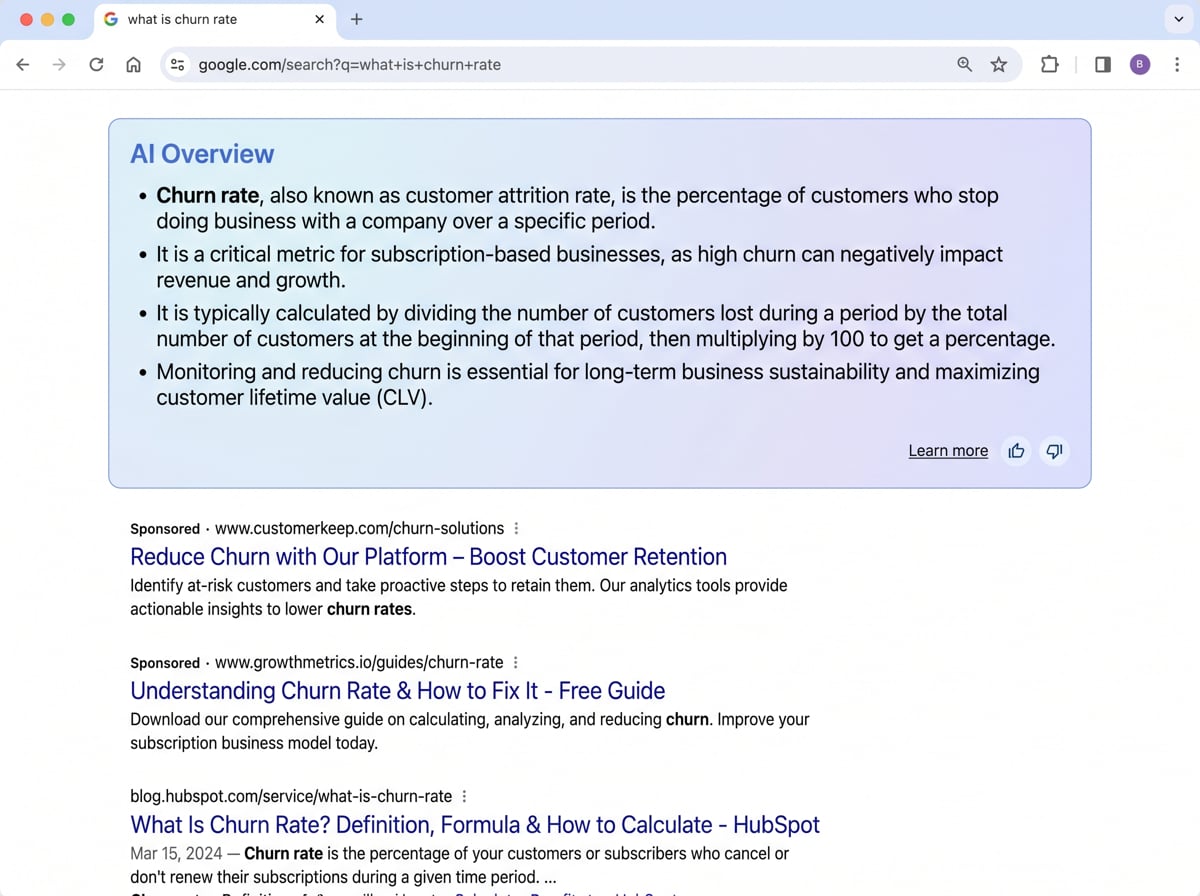
A modern Google SERP with AI Overview pushing organic results further down the page.
Zero-Click Isn't a Bug. It's the Feature Now.
Zero-click search has been growing since Google launched featured snippets in 2014. What's changed is the scale. AI Overviews now appear in roughly 30% of queries, and on mobile the zero-click rate sits somewhere around 75–77%. That's not a blip. That's the new default user behavior.
Here's the reframe that took me a while to really absorb: a zero-click result is not a failure. If your content is the source Google chose to surface in a snippet or AI Overview, you won the SERP. You're the authoritative answer. The user just didn't need to visit your page to benefit from it. The failure is in measuring that outcome as zero.
💡 Did You Know
76.1% of URLs cited in Google AI Overviews also rank in the top 10 organic results. Strong traditional SEO is still the best foundation for AI visibility. But being cited in an Overview now adds a second layer of authority that never shows up in your traffic report.
Think about what it means when your definition shows up in a Google AI Overview for a competitive industry term. Thousands of people read that answer. They associate that explanation with your brand. They might search for you by name six weeks later. They might mention you to a colleague. None of that shows up in Google Analytics as an organic session, but all of it is SEO working exactly as it should.
AI Overviews Are Only Half the Problem
When traffic drops, everyone blames AI Overviews. It's a reasonable instinct and it's also often incomplete. There's a second major force reshaping the SERP that gets much less attention: paid re-monetization.
Between early 2025 and now, text ads have quietly gained 7 to 13 percentage points of click share across multiple industries, while organic results have lost visibility. Google is selling more of the page to advertisers, and those ads are pushing organic listings further down, particularly on commercial-intent queries. There's also a less talked-about algorithm dynamic worth understanding here: query fanout, which can cause sudden traffic drops that have nothing to do with AI Overviews or ads at all.
⚠️
Important Distinction
These two problems need different fixes. Zero-click behavior from AI Overviews is a content strategy problem. Losing clicks to paid listings is a commercial and paid strategy problem. Diagnosing which is which before you optimize will save you months of chasing the wrong solution.
Imagine pulling the SERP data on a site that's down 18% year-over-year. Half the decline could be happening on commercial-intent keywords where ads have taken over the top three positions. That content might not have gotten worse at all. The SERP just looks different. Fixing the content on those pages won't recover those clicks — the answer there is a paid strategy conversation, not a content rewrite.
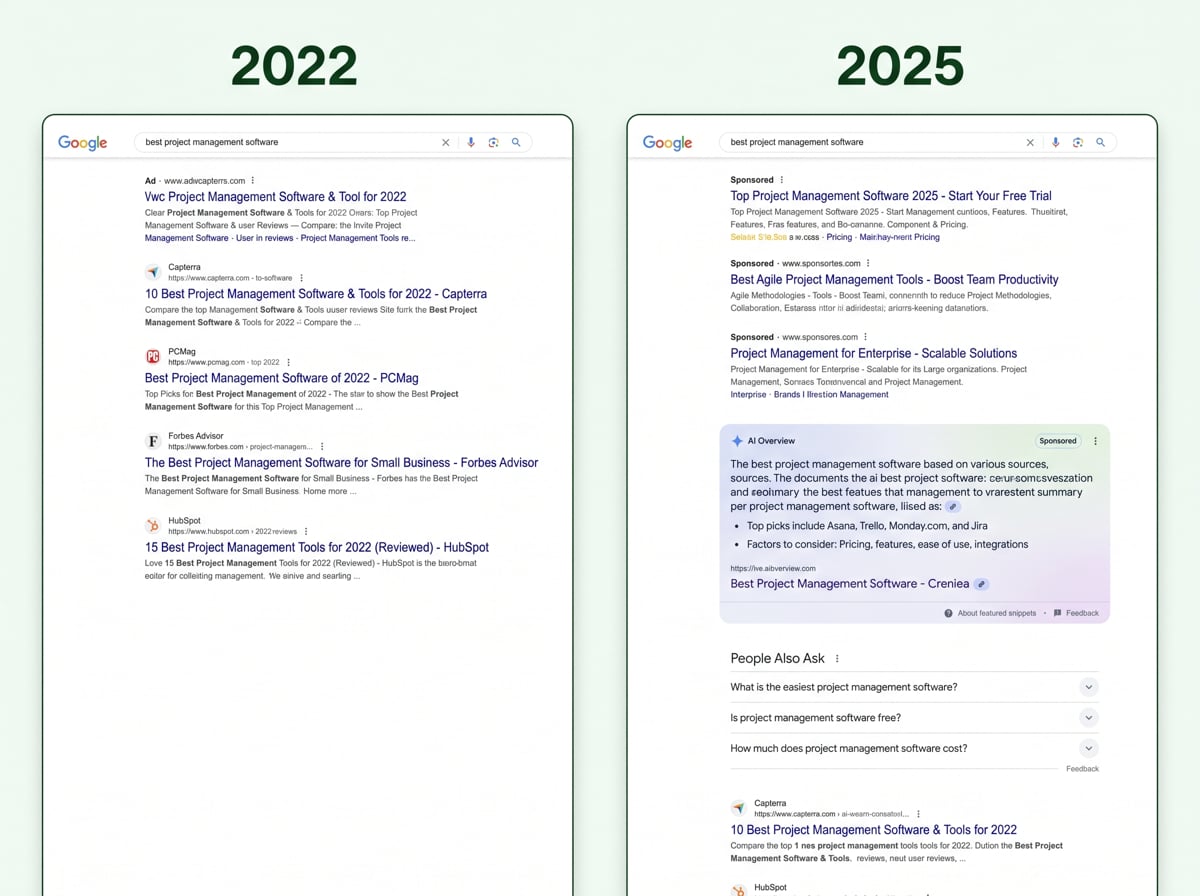
Then vs. now — more ads and AI Overviews are dominating the first page of search results.
Always diagnose before you optimize. Traffic declines rarely have a single cause.
Visibility and Traffic Have Decoupled
The old SEO logic was clean: rank higher, get more clicks, drive more traffic, grow the business. That chain is broken now. Visibility and traffic have decoupled, and if you're still reporting on only one of them, you're telling half the story.
Here's a scenario I think about often. Say you've got an article ranking at position one for a competitive informational keyword. You own the featured snippet. You're cited in the AI Overview. Tens of thousands of people in your target market read your definition every month. Your impressions in Google Search Console are climbing. Your branded search volume is rising. Your traffic from that keyword? Flat. Maybe slightly down.
Now compare that to ranking at position four for the same keyword, no snippet, no AI Overview mention. You get some clicks. But your brand isn't the one people associate with the authoritative answer. Which is better for your business? The first, almost certainly. But only the second version shows up favorably in a traffic-first report. That's the measurement gap we need to close.
📋 Old vs New: What to Track
| What We Used to Track | What We Should Track Now | Status |
|---|---|---|
| Organic sessions | Impressions + click-through rate together | Evolving |
| Keyword ranking position | SERP feature ownership rate | New |
| New users from organic | Branded search volume trend | New |
| Last-click attribution | SEO-assisted conversions (multi-touch) | Core |
| Individual keyword rankings | Topic cluster coverage rate | New |
| Domain authority score | AI Overview citation rate | New |
The Five Metrics That Actually Tell the Story
A practical framework you can start using in your next report.
1. Search Visibility Metrics
Before anything else: are you showing up? Google Search Console is still your most direct window into how often Google is surfacing your content. Impressions growing while clicks stay flat is a zero-click signal, not a performance problem. Track snippet ownership rate quarterly too — what percentage of your target keywords trigger a featured snippet or People Also Ask box that you own?
Share of voice is the metric that brings this into competitive context. It measures what percentage of total SERP real estate your domain controls across a topic cluster. When you map this across an entire topic cluster you'll almost always find a few obvious gaps that are easier to fix than you expected.
2. Brand Authority Signals
Zero-click exposure builds brand familiarity. But you can only see it if you're looking for it.
Branded Search Volume
Are more people searching for you by name over time? Rising branded search is often a downstream effect of strong SERP presence.
Direct Traffic Trend
When someone remembers a brand from a SERP interaction and navigates directly later, that shows up as direct traffic. Most SEO teams never connect this back to their content.
Backlinks & Mentions
Increasing third-party references to your brand indicate topical authority growing beyond what organic sessions capture.
The branded search trend is particularly telling. People see your brand in snippets and Overviews, then search for you directly weeks later. That's a real conversion path, it just doesn't look like one in a standard attribution report.
3. Content Citation in AI Search
This is the newest metric category and also the one most teams are still ignoring. Track whether you're being cited in Google's AI Overviews for your target queries. The goal is the double win: rank in the traditional results and get cited in the AI Overview answer. That combination is what drives the kind of brand association that compounds over time.
🤖
Watch This Space
The infrastructure for measuring AI citation is still catching up to the reality of AI search. But the brands building processes for it now — including manual tracking of Perplexity and ChatGPT citations — will have a real data advantage in 12 months.
Beyond Google, are you being referenced in Perplexity or ChatGPT answers? The brands that treat AI citation tracking seriously today will have historical data to benchmark against when the measurement tools catch up. If you want a tactical breakdown of how to actually get your content cited, we wrote a full playbook on how to get AI Overviews to cite your content instead of your competitors.
4. Assisted Conversion Signals
This is where the real SEO ROI lives, and it's the most underreported metric in the game. Organic search shapes buying decisions long before someone converts. In a zero-click world, that influence starts even earlier. Traffic-only reporting misses the entire middle of the funnel.
In GA4, you can build a custom funnel that counts conversions where organic search appeared at any point in the journey, not just as the last touch. When you set this up, the numbers often tell a completely different story — you might find that 30–40% of won deals touched organic search somewhere in the journey, including several from content that drove almost no direct traffic because it lived primarily as a featured snippet.
"The SEO was working. You just weren't building the right reporting to show it."
Time-lag analysis matters here too. In zero-click environments, the path from SERP exposure to conversion is longer. A user reads your snippet in January, remembers your brand in March, searches for you directly, and converts. Multi-touch attribution captures that chain. Last-click attribution makes your SEO look useless. This is especially true in longer sales cycles like B2B SaaS, insurance, or enterprise software.
5. Keyword Footprint and Topic Coverage
Individual keyword rankings are a rearview mirror. Topic coverage tells you where you're headed. Cluster coverage rate measures what percentage of the related keyword set your domain ranks for across a given topic. Gaps in coverage are gaps in authority. Both AI engines and Google's ranking algorithms increasingly favor sources that cover a topic comprehensively. If your content isn't ranking despite solid on-page work, the issue is usually at the cluster level — this piece breaks down exactly why content fails to rank and what to actually do about it.
📊
Quick Check
Pick your top three topic clusters. For each one, list every keyword variation your target audience might search. How many of those does your domain actually rank for? That coverage gap is your content roadmap.
How to Present This to a Stakeholder Who Just Wants to See Traffic Go Up
The hardest part of zero-click SEO isn't the strategy. It's the meeting after.
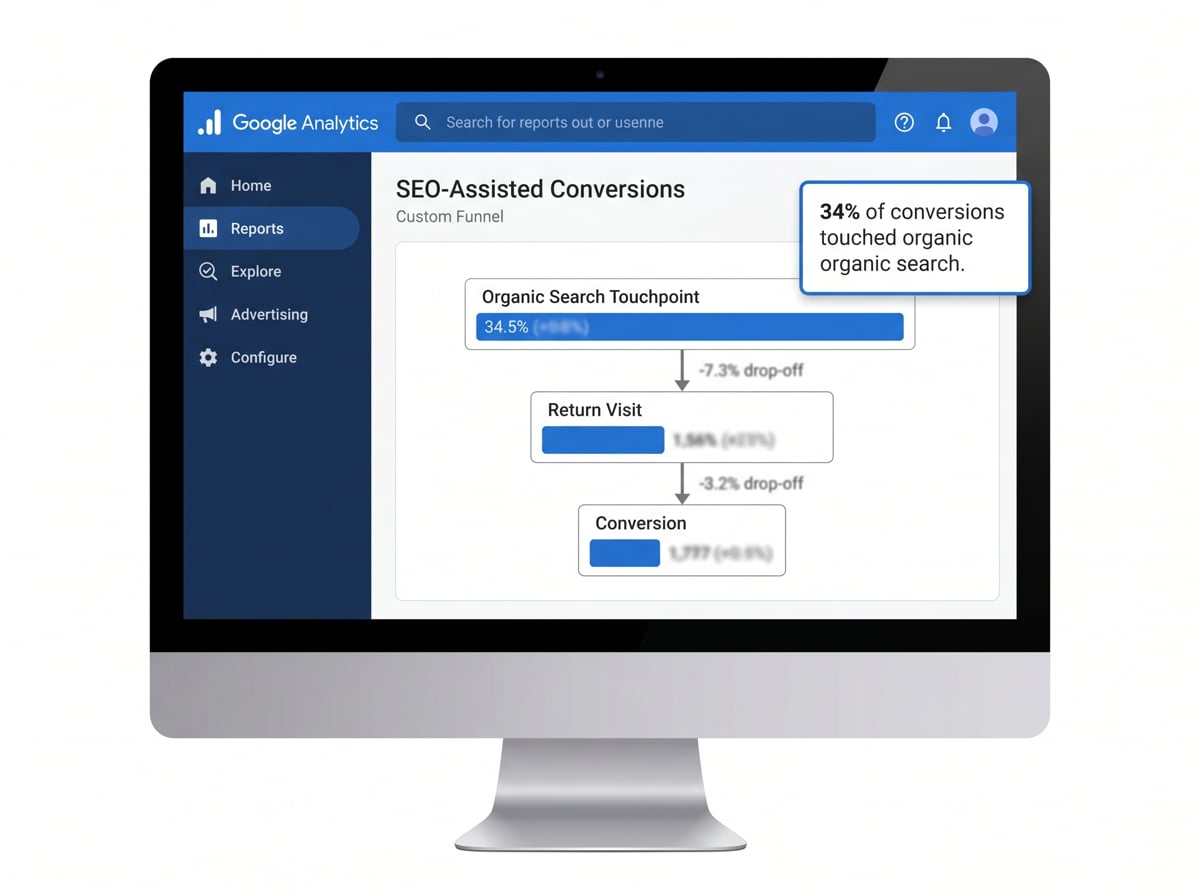
A GA4 dashboard displaying the SEO-assisted conversions report — a far more complete picture than traffic alone.
Lead With the Reframe, Before the Data
Most executives equate SEO with traffic because that's how it's always been reported. Before you show a single number, shift the frame. Something like: "Search behavior has fundamentally changed. More than half of Google searches now end without a click, so traffic alone no longer reflects our actual search presence." That one sentence changes how every number that follows gets interpreted.
Replace the Single Traffic Graph With a Visibility Scorecard
Here's what I use — five data points, same simple format every month:
📋 Visibility Scorecard Template
| Metric | What It Measures | Source |
|---|---|---|
| Impressions | How often we appear in search | Google Search Console |
| Snippet / Feature Ownership | % of target keywords where we own the answer box | Manual audit + GSC |
| Branded Search Volume | Are more people searching for us by name? | GSC branded queries / Google Trends |
| SEO-Assisted Conversions | Conversions where organic appeared in the journey | GA4 custom funnel |
| Organic Traffic | Direct sessions from search | GA4 (one data point of five, not the headline) |
This is mostly data you already have. The shift is in how you arrange and present it. Suddenly you're telling a coherent story instead of defending a single declining number.
Address the "But Traffic is Down" Question Before It's Asked
Don't wait for it to come up. Lead with it. Run through three things: first, provide industry context that organic CTRs are declining across the board because of SERP structure changes, not just on your site. Second, show the SERP composition shift and whether the decline is from AI Overviews, more ads, or both. Third, pivot to what's growing — impressions, branded search, and assisted conversions.
Where to Start If You're Behind on This
You don't need to overhaul everything at once. If you want to prioritize, these three things come first before you touch a single piece of content:
- Set up SEO-assisted conversions in GA4. If you don't have this, you're flying blind on the actual ROI of your organic program.
- Start tracking branded search volume monthly in Google Search Console. Filter by branded queries, plot the trend, connect it to your SERP presence activity.
- Do a quarterly snippet audit for your top 20 target keywords. Note which trigger featured snippets, which ones you own, and which you're missing.
Once those three are running, layer in AI Overview citation tracking manually for your priority queries. It takes 20 minutes a week and it will give you data that almost none of your competitors are collecting yet.
🎯
The Bottom Line
The brands that win SEO in the next two years are not necessarily the ones who rank highest. They're the ones who show up most authoritatively across the full SERP, get cited in AI answers, build brand recognition through zero-click exposure, and have the reporting in place to prove it all actually works. Start building that now.
If you want to go deeper on getting cited in AI answers specifically, the AI Overviews citation playbook is worth reading alongside this one. And if you're trying to diagnose why your traffic is dropping before you do anything else, the query fanout explainer might be the missing piece of the puzzle. And if the bigger question on your mind is why raw rankings matter less than who's actually delivering the answer, we make that case in full in Evergreen Content Is Dead. What Replaces It Isn't a Tactic, It's a Person.
SEO has gotten more complex. But the teams that adapt their measurement approach first will have a real competitive advantage. The strategy itself — strong content, clear topical authority, well-structured pages — hasn't fundamentally changed. The scoreboard has.
