


SEO / GEO / LLM
Let me be direct with you: the search landscape has fundamentally changed, and most enterprise marketing teams are still running last decade's playbook. I spend a lot of time talking to digital leaders, and the pattern I keep hearing is the same one. Organic traffic is slipping, attribution is getting murky, and nobody can quite explain why a piece of content that used to perform well has quietly gone dark.
The answer, more often than not, is Answer Engine Optimization, or AEO. And it is not a trend you can afford to sit out.
More users are getting direct answers from ChatGPT, Perplexity, Claude, and Google's AI Overviews, and those answers are influencing purchasing decisions before a user ever visits your website. If you are not the source those AI engines are pulling from, you are invisible in the moment it matters most.
This guide lays out exactly how enterprise brands should think about AEO in 2025, from assessing where you stand today to building the kind of content, technical foundation, and authority that earns you a place in AI-generated answers.
💡 Did You Know
According to SparkToro research, AI-powered search experiences are increasingly intercepting queries that previously drove organic traffic, especially for informational and comparison-stage searches. Brand visibility in those answers is becoming a core growth lever, not a vanity metric.
First, Know Where You Stand
Before you can build a strategy, you need an honest read on your current AEO maturity.
One of the most common mistakes I see enterprise teams make is jumping straight into tactics without establishing a baseline. They start publishing FAQ schema everywhere or restructuring pillar pages without understanding whether their content is being crawled by AI bots at all, whether their brand is being mentioned, or whether the sentiment around their brand in AI responses is actually positive.
Your starting point determines what your first moves should be. Based on what I have seen across hundreds of enterprise brands, there are five distinct maturity stages. Where you fall on this matrix shapes everything that follows.
Stage 1
Reactive
You are losing organic traffic and are not sure why. You have no formal AEO strategy, SEO and content are siloed, and AI visibility is something you check manually and inconsistently.
Stage 2
Operational
You are tracking AI mentions, using an AI writing tool weekly, and SEO and content are aligned on a quarterly plan. Executives are aware of AEO but not yet actively sponsoring it.
Stage 3
Strategic
Cross-functional teams including brand, PR, product, and analytics are engaged. You have shared dashboards and can speak to AI search share of voice relative to competitors.
Stage 4
Authority-First
AI engines consistently cite you as the primary source in your category. Your content strategy is focused on defending that position and building a long-term technological moat.
Stage 5
Agentic
AI agents run the routine work of monitoring, alerting, content scoring, and reporting. A small senior team governs strategy while automated systems handle execution and self-correction.
Be honest about where you are, not where you want to be. A B2B SaaS company that started tracking AI visibility last month should not be holding itself to the same benchmarks as an enterprise retailer that has been building AEO operations for a year. The matrix tells you what to prioritize, not what to aspire to.
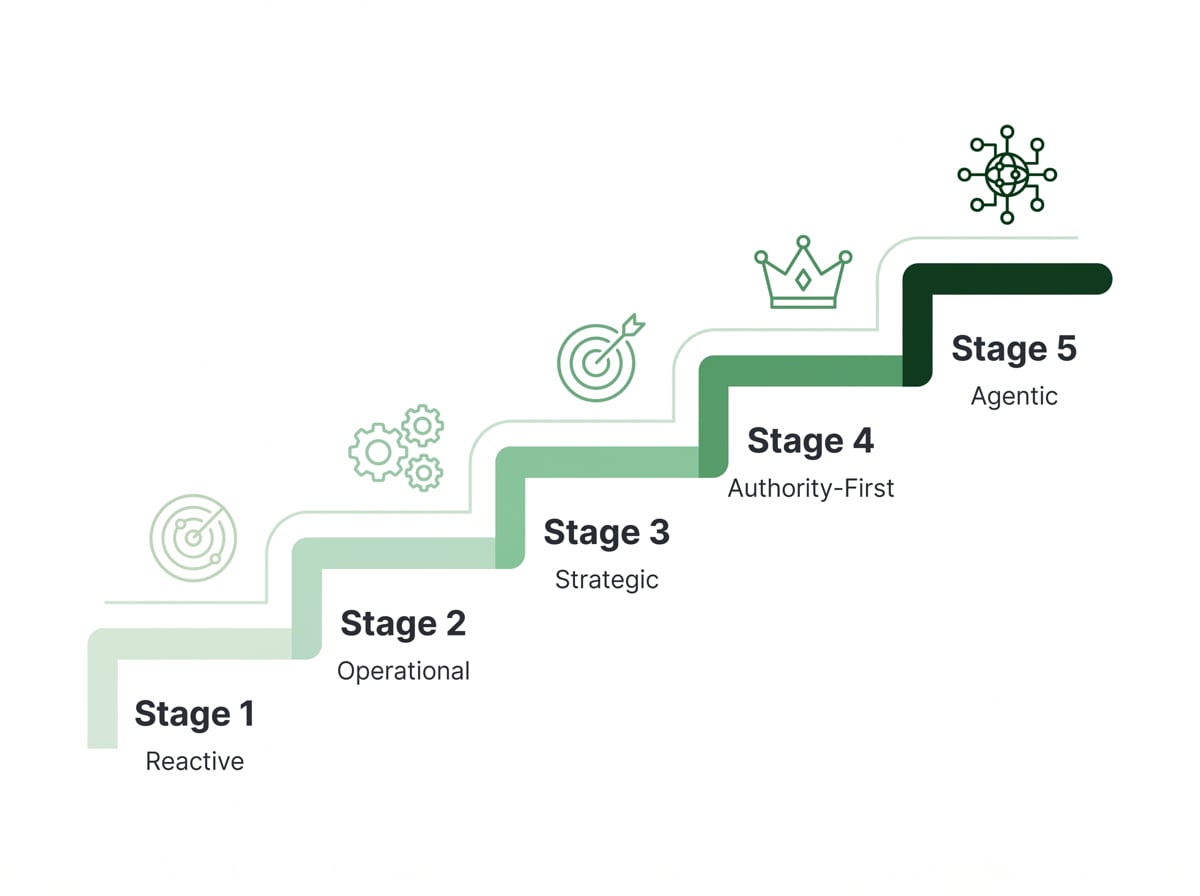
The AEO Maturity Matrix: five stages that define where your brand stands and what to prioritize next.
📌 Key Takeaway: Reactive brands should focus on baselining performance and quick wins. Operational brands should tighten cross-functional workflows. Strategic brands should connect AEO performance to pipeline and revenue. Let your maturity stage drive your priorities, not a feature wishlist.
Track the Right Prompts, Not Just Keywords
AI search is personalized in a way keyword tracking never prepared us for.
Traditional SEO gave us a clean model: find high-volume keywords, rank for them, measure traffic. AEO is messier and frankly more interesting. Two users asking similar questions can get completely different AI-generated answers depending on their context, phrasing, search history, and location. There is no single SERP to rank on.
What that means practically is that you need to track prompts, not just keywords. You need to identify the actual conversational queries your audience is using, build tracking around them, and revisit that list on a set cadence, quarterly at minimum, to make sure your tracked prompts still reflect how your buyers are searching.
A useful way to think about this: if your audience has shifted, your tracked prompts should shift with them. Stale prompt tracking will make your reporting drift from reality fast, and that disconnect will cost you when you are trying to justify AEO investment to leadership.
📊 Data Point
Research from Semrush shows that AI-powered search queries are significantly longer and more conversational than traditional keyword searches, often running 10 or more words. Your content strategy needs to account for this shift in how people phrase their needs.
The Four Pillars of a Strong AEO Strategy
Content, technical, authority, and measurement each play a distinct role, and they only work when they work together.
Content
What LLMs actually surface, cite, and pull from when generating answers.
Technical
What makes your content accessible and parseable to AI crawlers.
Authority
What earns you the citation. Trust, expertise, and third-party validation.
Measurement
How you know any of this is working and where to course-correct.
Pillar 1: Content That Earns Citations
Content is the raw material of AI search. LLMs are constantly pulling from pages across the web to construct answers, and the content they pull from shares a set of common characteristics. Understanding those characteristics is half the battle.
Map content to intent, not just topics
Intent generally falls into four categories: informational, comparative, evaluative, and transactional. Most enterprise brands over-invest in informational content and dramatically under-invest in comparative and evaluative content, which is exactly where purchase decisions get made.
When I audit a brand's content, I start by labeling every high-performing page by the intent it serves. If 80% of your content is informational, you are likely invisible for the prompts where buyers are actually comparing solutions. Those are the gaps your competitors are filling.
Write for chunkability
LLMs do not read pages the way humans do. They break content into semantically coherent chunks that can be retrieved and recombined to answer a prompt. This means every section of your content needs to stand on its own. A reader or an LLM should be able to drop into the middle of your article, read a single section, and walk away with a complete, useful answer.
In practice, that means clear topic sentences, self-contained paragraphs, headers that accurately preview what follows, and FAQ sections for any page serving consideration-stage research. FAQ sections are particularly high-impact because they map directly to how users ask AI questions, they are naturally chunkable, and when paired with FAQ schema, they give LLMs an unambiguous signal about what each section is answering.
Prioritize unique data and original research
Here is something I think gets undersold in the AEO conversation: originality is a trust signal. Anyone can prompt an LLM to write an article on a given topic. What sets your content apart is your brand's perspective, your internal expertise, and the data only your organization can provide.
A B2B healthcare SaaS company that publishes a data-backed report on hiring trends in healthtech is not just producing useful content. They are creating a primary source that news outlets, LinkedIn posts, and review sites will link back to, and that LLMs will cite when answering related prompts. Nobody can repurpose your statistics without crediting you, which compounds your owned and third-party visibility over time. This is really the same principle we unpack in Evergreen Content Is Dead. What Replaces It Isn't a Tactic, It's a Person: content that can be fully reproduced by an LLM from public information has no moat, while content built on something only you know or have measured does.
This distinction between content that gets cited and content that gets ignored is something we went deep on in our analysis of why enterprise AI content scaling strategies are failing — and specifically why the highest-maturity organizations are the only ones prioritizing original research over volume.
🔬 Research Insight
A study by BrightEdge found that content containing original data, proprietary research, or expert author credentials is significantly more likely to be cited in AI-generated responses than generic content covering the same topic. The E-E-A-T framework Google introduced is increasingly how LLMs evaluate source quality too.
Do not hide content in formats LLMs cannot read
This is an easy one to miss. Some of the most important content on your site might be completely invisible to AI. LLMs generally cannot read images used as tables or infographics, content rendered only in JavaScript, gated content behind forms or paywalls, or videos without a transcript.
If your best research report exists only as a gated PDF, AI engines likely will not cite it, regardless of how good the content is. The strategic tension is real: gated assets drive leads but kill AI visibility. The solution I recommend is to publish an HTML summary page with your key data points and insights accessible without a login, then gate the full asset for lead gen purposes. That way you capture both.
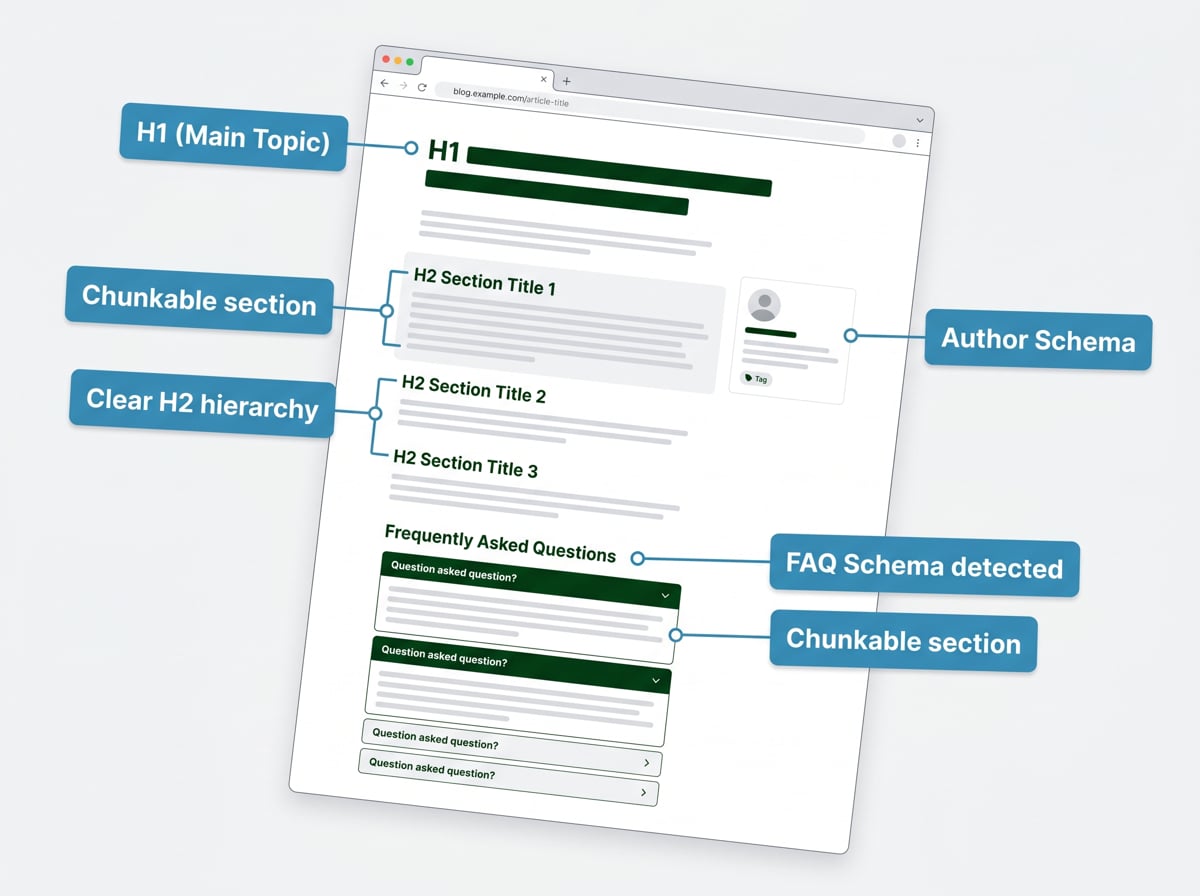
A well-structured article page annotated for AEO — clear hierarchy, chunkable sections, and schema signals that make it easy for LLMs to parse and cite.
Pillar 2: Technical Health as an AEO Foundation
Great content that cannot be crawled is invisible. Technical AEO is what makes your content accessible in the first place, and the bar has shifted because AI crawlers behave differently than Google.
The underlying logic is worth understanding regardless of which crawler you're optimizing for. Google's own crawl budget model, the resource math that decides which pages even get evaluated in the first place, still governs a huge share of your visibility, and it works differently than most teams assume. We unpack that mechanism in detail in Why Scaled AI Content Keeps Collapsing in Google, including why a strong first-month traffic spike often means nothing at all.
Schema markup is non-negotiable
Schema markup makes it faster and easier for LLMs to understand what a piece of content is and what its purpose is. The faster an LLM can parse your content, the more likely it is to include your brand in a response. The types that matter most for AEO specifically are worth listing out.
📋 Copyable Reference: Schema Types for AEO
| Schema Type | Where to Use It | Why It Matters for AEO |
|---|---|---|
| Article Schema | Blog posts, news, editorial content | Tells LLMs who wrote it, when it was published, and what it covers |
| FAQ Schema | Pricing, product, buying guide pages | Maps directly to how users ask AI questions; highest-leverage type for citations |
| Product Schema | Product pages (eCommerce) | Covers price, availability, reviews, SKU, critical for AI shopping queries |
| Organization Schema | Sitewide | Helps LLMs consistently recognize and reference your brand |
| Person / Author Schema | Author bio pages, bylined content | Establishes authorship and expertise; increasingly weighted by LLMs |
| HowTo Schema | Tutorials, step-by-step guides | Lets LLMs pull structured instructions directly into responses |
| Review / AggregateRating Schema | Product and service pages | Sends trust signals and helps products surface in AI-generated recommendations |
Most AI crawlers do not render JavaScript
This is a technical reality that catches a lot of teams off guard. If critical content on your pages is rendered via JavaScript, including interactive elements, accordions, or tab-based content, there is a good chance AI crawlers are not seeing it at all. The fix is straightforward: move important content into raw HTML. Use semantic HTML tags like <article>, <section>, and <header> to explicitly signal content structure.
Monitor AI bot crawler activity directly
One signal I think is still underused is tracking how frequently AI crawlers are visiting your pages and which pages they are ignoring. Research has shown that AI crawlers often visit pages far more frequently than traditional search engines. In one documented case, ChatGPT's crawler visited a newly published page eight times more often than Google in just five days, and Perplexity crawled it three times more often.
That speed cuts both ways. New content can start influencing AI responses within hours of going live, but if your content is not technically sound at the moment it publishes, AI bots may not return to re-evaluate it. Unlike Google, there is no request re-indexing button for AI crawlers.
⚡ Action Item
Set up server log analysis to track visits from AI bots including GPTBot, ClaudeBot, and PerplexityBot. If these crawlers are hitting your blog pages but ignoring your product or feature pages, that is a structure or schema issue worth addressing immediately. The pages they ignore are the pages they will not cite.
Pillar 3: Building Authority That LLMs Trust
Getting your content crawled is one thing. Getting cited is another. LLMs do not surface sources randomly. They prioritize sources they have reason to trust, and that trust is built through expertise, reputation, and third-party validation across both your owned content and everything your audience reads about you elsewhere.
Brand reputation is now a ranking signal
This is a shift that a lot of SEO strategies have not caught up with yet. In traditional search, you could rank well even if your brand reputation was average, as long as your on-page and off-page signals were strong enough. In AI search, brand reputation is baked into the equation from the start. LLMs want to surface sources that users trust, and sentiment is one of the clearest trust signals they have access to.
For B2B brands, authority typically comes from thought leadership, named internal subject matter experts, original research, and substantive case studies. For B2C and eCommerce brands, it shows up differently: detailed accurate product pages with real specs, verified customer reviews surfaced directly on product pages, buying guides that genuinely help shoppers decide, and clear policies. The principle is the same in both cases. If you are generating generic AI content without your brand's real expertise woven into it, LLMs will mostly ignore you and surface someone else.
Third-party sources shape your AI narrative
Your brand sentiment is not only shaped by what is on your site. Review platforms like G2 and TrustRadius, analyst coverage from Gartner or Forrester, affiliate roundups, Reddit threads, and industry publications all feed into how AI describes your brand.
I looked into this recently and found a compelling example. A running gear review site called The Run Testers published a Best Running Shoes of 2026 guide. When that query goes into Claude or Perplexity, that article shows up as one of the top cited sources alongside major publishers like Sports Illustrated. For any athletic brand not mentioned in that guide, that is a citation gap their competitor is filling instead.
📣 Community Signal: According to Woodside Ventures' own research, Reddit conversations carry outsized weight in AI citations when they appear. LLMs treat authentic community discussions as trust signals, which means a negative thread about your brand on a niche subreddit can quietly shape how AI describes you to potential buyers. Monitoring third-party sentiment is not optional anymore.
Pillar 4: Measuring What Actually Matters
Here is where I want to push back against some of the noise in the AEO space right now: prompt volume is not a reliable metric, and any platform selling you on it as a primary KPI is selling you something that will not hold up to scrutiny.
Because AI search is so personalized, it is extremely difficult to accurately tally how often a given prompt is searched in a way that creates a clean parallel to traditional search volume. Chasing that number will frustrate your team and mislead your leadership.
Instead, focus on the metrics that actually tell you something meaningful.
📋 Copyable Reference: AEO Metrics That Matter
| Metric | What It Measures | Why It Matters |
|---|---|---|
| Citations | How often AI responses link directly to your content | Clearest indicator that LLMs treat your content as authoritative; drives referral traffic |
| Brand Mentions | How often your brand appears in AI-generated responses | Primary signal of whether LLMs recognize you as relevant to the topics you care about |
| Share of Voice | Your mentions and citations relative to competitors | Quantifies whether you are winning or losing ground in the topics that matter |
| Brand Sentiment | How LLMs discuss your brand and what sources drive that | Sentiment has become a real ranking signal; negative perception has real cost |
| Persona + Intent Coverage | How your content performs across specific buyer types and funnel stages | Tells you if you are showing up for actual buyers in the moments that matter |
| AI Bot Crawl Activity | How often GPTBot, ClaudeBot, PerplexityBot visit your pages | Strong crawl activity is a precursor to visibility; pages not crawled cannot be cited |
| Traditional Search Performance | Rankings, organic traffic, SERP visibility | AEO is an extension of SEO, not a replacement; you need both to see the full picture |
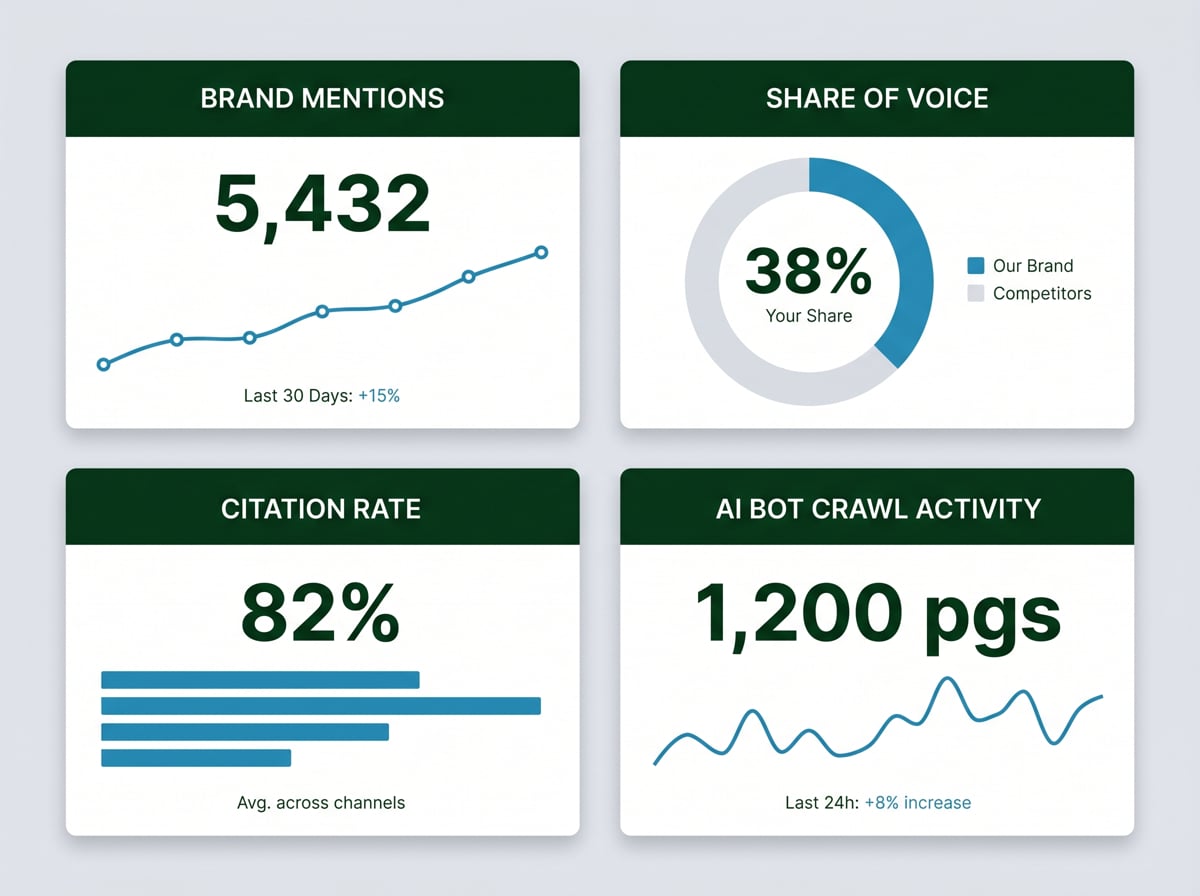
An AEO metrics dashboard tracks what actually matters — citations, brand mentions, share of voice, and crawl activity — all in one view.
Translate AEO into language executives understand
Most executives do not care about prompt-level visibility because it feels removed from core business goals. Your job is to connect AEO performance to pipeline, revenue, and ROI. For a B2B brand, that means tying AI visibility and citations to demo requests, trial signups, and qualified pipeline. For a B2C brand, it means connecting AI-driven traffic to conversion rates and average order value.
If you cannot make that connection, your AEO budget will always be at risk. The brands that have secured serious investment in AEO are the ones that built the data infrastructure to tell that story clearly.
How to Operationalize Enterprise AEO at Scale
Knowing the four pillars is one thing. Executing them consistently across a large organization is another challenge entirely.
The shift I am seeing among the more advanced enterprise teams is toward agentic AEO, meaning autonomous workflows powered by AI agents that can run an entire end-to-end process in minutes that might have taken a human team days. Competitive intelligence briefings, content gap analyses, exec-ready reports, and technical health reviews are all being automated in ways that were not practical even two years ago.
But this only works when the data underneath it is reliable. Agents are only as powerful as what they are built on, and generic agents running on thin or unreliable data will produce thin, unreliable results. The brands pulling ahead are the ones investing in quality data infrastructure first, then layering agents on top of it.
🔗 Related Reading: If you are thinking through how to build a content operation that actually scales without sacrificing quality, our breakdown of why most enterprise AI content strategies are failing covers the human-in-the-loop workflows and quality frameworks that separate the brands winning at scale from the ones getting penalized for it.
You still need humans in the loop
No matter how powerful your AI workflows become, you need people reviewing the output. Agents can hallucinate. They can apply the wrong brand voice or misread nuance. They can follow instructions too literally and produce content that is technically accurate but tonally off. Your teams are the safeguard against those risks, validating recommendations before they go live and making sure output stays on-brand.
Human-in-the-loop is not a limitation of agentic AEO. It is what makes agentic AEO trustworthy enough to operationalize in the first place.
Safeguarding Your AEO Strategy Long-Term
What works today can quietly stop working tomorrow. Staying visible requires always-on monitoring and a strategy that evolves with the landscape.
AEO is not a project you complete. It is a discipline you maintain. The brands that stay visible in AI search are the ones treating monitoring as a continuous effort, not a quarterly audit.
📅 Monitoring Cadence: A Reference Framework
- Continuously (real-time alerting): Site uptime, broken schema on high-impact pages, unexpected 404 spikes, Core Web Vitals regressions, AI bot crawl activity on top pages
- Weekly: Brand mentions and citations across AI engines, share of voice shifts, newly published content performance, crawl frequency changes
- Monthly: Brand sentiment trends, competitive movement, topic-level performance, content audit priorities
- Quarterly: Strategic benchmarks against industry peers, KPI alignment with business outcomes, prompt strategy reviews
AEO is an extension of SEO, not a replacement
I want to end on this point because I think it gets muddied in the industry conversation. The fundamentals of good SEO, technical soundness, strong content, real authority, and accurate measurement, are the same fundamentals that drive AEO. What has changed is the surface you are optimizing for and the metrics you use to measure success.
Brands that treat AEO as a replacement for SEO end up blind to a large portion of their search visibility. Brands that treat it as an extension, tracking both traditional search performance and AI visibility holistically, are the ones with a complete picture of where they stand.
📚 Further Reading
For a deeper look at how AI search is intersecting with traditional content strategy, check out our post on why evergreen content is dead and what replaces it, our breakdown of why scaled AI content keeps collapsing in Google, and our roundup of the search metrics enterprise teams should be tracking in 2025.
Follow the industry, but stay skeptical
AEO is still in early innings. New AI engines are launching, existing ones are updating their models, and the way LLMs weigh different signals keeps evolving. It is a lot like Google algorithm updates, except it is happening across half a dozen platforms simultaneously. Stay close to trusted voices in the space, pay attention to how category leaders are framing new developments, and treat your AEO strategy as a living document rather than a finished plan.
The brands that win here are not the ones with the biggest budgets or the most content. They are the ones that can read the landscape clearly, move quickly when it shifts, and consistently do the foundational work well. Strong content, sound technical infrastructure, real authority, and honest measurement. Everything else is built on top of those four things.
